

Marisol, 48, rehearsed in the car. She had it ready: the client's name that went blank mid-meeting, the paragraph she read four times. Then the doctor sat down, glanced at the screen, and Marisol heard herself say, "It's probably nothing. I'm just tired." Ten minutes later she was back in the parking lot with nothing written down. (Marisol is a composite, drawn from many women's experiences.)
If you want to talk to your doctor about brain fog and you're afraid the same thing will happen, here is the short version. Your job is not to convince anyone. It is to describe what is new, when it started and how it affects your days, and to bring that on one page. This entry walks you through before, during and after the appointment, with a one-page summary you can write today.
Why it is hard to talk to your doctor about brain fog
Most of us minimize before we begin. We hand the doctor an easy exit ("it's probably stress") before we have said what we came to say.
Then there is the fog itself. A white paper of the International Menopause Society lists trouble recalling words among the usual complaints, along with losing your train of thought and forgetting appointments (Maki & Jaff, 2022). So the very thing you came to describe can get in the way of describing it, in a small room, with the clock running. That is why most of the work is best done before you walk in. You are not asking for a favor. You are describing something new that is affecting your life.
You are not asking for a favor. You are describing something new that is affecting your life.
If you are still working out whether this is brain fog at all, start with what perimenopause brain fog is and what it is not.
When not to wait for a routine appointment
Some changes should not wait for a page of notes. Contact your doctor promptly, or seek urgent care, if a change in your memory or thinking is sudden or getting worse quickly, if you are getting lost in places you know well, or if your safety is affected. Brain fog can have more than one explanation, and a doctor is the person who can sort through them with you. Everything below is meant to support professional care, and it does not replace it.
Before: write a one-page appointment summary
Appointments are short, and one tidy page is easier to act on than a long explanation under pressure. Write it in the words you would use with a friend. You don't need to sound medical. You need to sound specific.
How long: about 15 minutes to write, plus about 5 minutes to read it aloud the day before. What you need: a sheet of paper, a pen and any notes you have kept, such as a 14-day menopause brain fog map. If you have the map, bring it to the appointment too.
A gentle note: if writing this down stirs up fear, keep each line short. You can stop at any point and come back to it tomorrow.
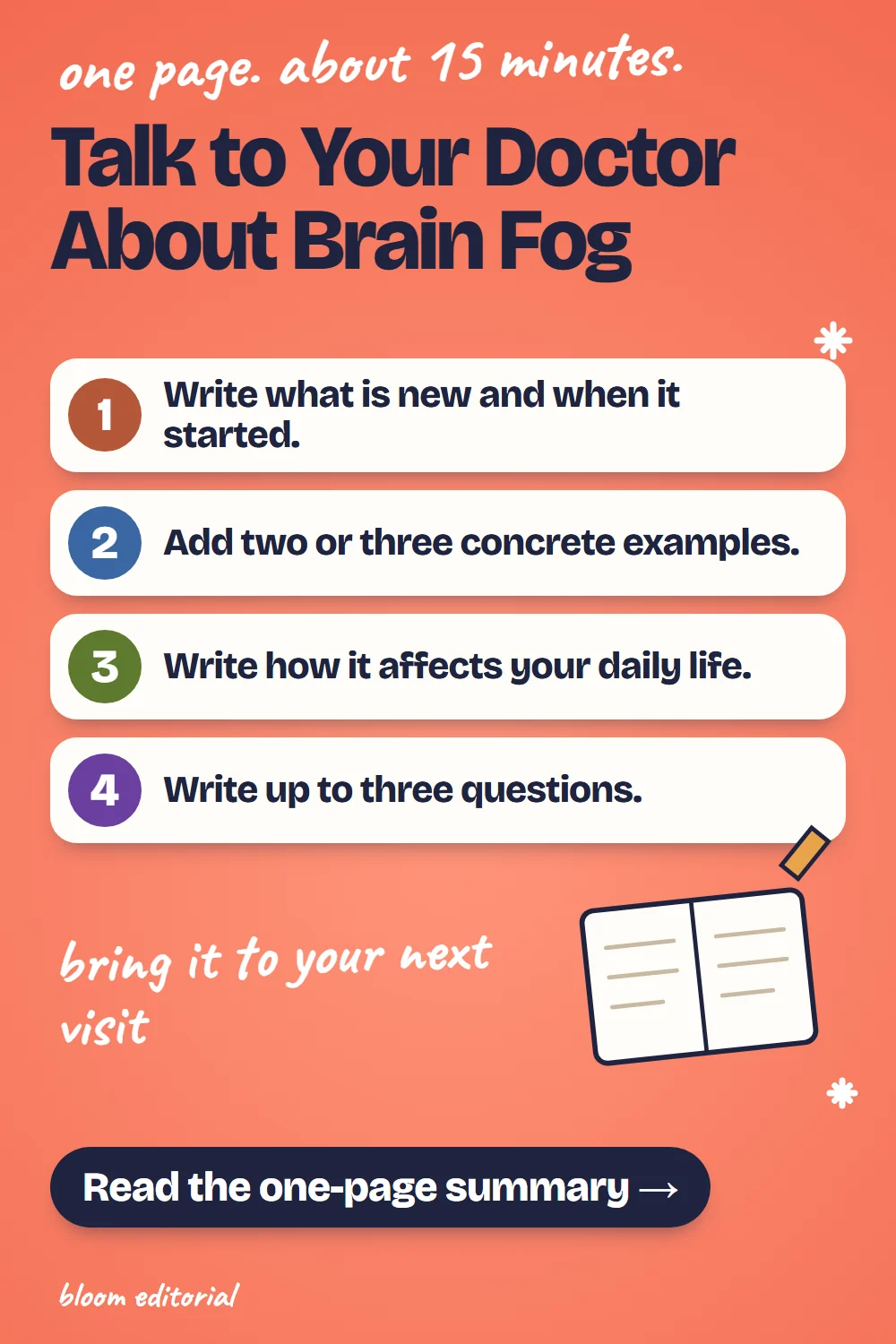
- Write what is new and when it started. One or two lines. For example: "This level of forgetting is new for me. It started about six months ago."
- Add two or three concrete examples. Choose the ones that happen most often: a lost word in a meeting, reading the same paragraph three times, walking into a room with no idea why.
- Note what it seems to travel with. From your map, if you kept one: poor sleep, night sweats, changes in your cycle, stressful weeks. If you have no notes, write what you have noticed. "Not sure" is an honest answer.
- Write how it affects your daily life. Work, relationships, confidence. This is often the sentence that gets heard. For example: "It is affecting my work. I'm struggling to follow conversations."
- List the medicines and supplements you take. Names are enough. It saves you from trying to remember them in the room.
- Write up to three questions. Written down, not memorized. Put the one you most need answered first.
- Read the page out loud once, the day before. Notice which line was hardest to say. That is probably the most important one, so underline it.
What to bring: the page (one copy to hand over and one to read from), your map or notebook, a pen and, if it helps, someone you trust to take notes.
What you might notice: relief, because on paper it often looks smaller than it felt in your head. Tears when you read it aloud, which are common. A feeling that the page looks thin; specific beats long. Or nothing much at all, which is fine too. If the page starts to feed the worry, put it down and finish it tomorrow.
When to use it: the week before an appointment; the night before, for one quiet read; and before any follow-up visit, with the new questions at the top.
This summary comes from Chapter 7 of The Perimenopause Brain Fog Workbook, "Talk to Your Doctor About Brain Fog" (Exercise 07b). The chapter adds a timeline of when it started, a practice run out loud, phrases for when you feel dismissed and an after-visit review. The paperback prints the summary as a page to take with you, plus a one-line-per-visit appointment log.
During: what to tell your doctor about brain fog
Start by reading your first line, word for word. Reading from a page is not a weakness. It is preparation. Here are some example phrasings that keep the conversation specific; use your own words if they fit better:
- "This is new for me. I don't normally forget like this."
- "It is affecting my work."
- "I tracked it for two weeks, and I'd like to show you what I found."
- "My worst days seem to follow my worst nights."
- "I'm frightened this means something worse, and I'd like to talk about that."
That fourth line is worth saying if your notes show it. The International Menopause Society white paper names hot flashes, disturbed sleep and mood among the things that influence thinking at midlife (Maki & Jaff, 2022). Your doctor can help you work out what a pattern means for you.
Some example questions, to choose from for your page:
- "Could this be related to perimenopause?"
- "What else would you want to rule out?"
- "Are there sleep or mood factors we should look at alongside this?"
- "If we try something, how will we know whether it's helping?"
The second question is a fair one. A guide written for health professionals notes that brain fog is not always hormonal, and it lists other illnesses, sleep and medication among the things to consider (British Menopause Society, 2026). Asking does not mean something else is going on. It means you have both looked.
If you hear "it's probably just stress," you might say, for example: "I understand. I'd still like to make sure we've considered other possibilities. Can we look at this together?" That is not confrontation. It is advocacy.
Before you leave, ask: "Can you tell me in one sentence what we decided today and what happens next?" Write the answer down, or ask them to.
After the perimenopause doctor appointment: a five-minute review
You will remember things in the car and may forget exactly what comes next. So write a short review within 24 hours. Four lines are enough:
- What I heard: in plain words, what the doctor said might be happening.
- What we decided: the next step, whether that is a follow-up, a referral or waiting and watching.
- What I still need to ask: the question from the drive home. It becomes the first line of your next summary.
- How I feel about it: relieved, worried, frustrated. Honest, not polished.
If the appointment left you feeling unheard, write that down too: "I didn't feel heard about the lost words. I still want to ask about sleep." It is information for the next conversation, with the same doctor or a different one. Let's Talk Menopause, a US nonprofit, has a finder for menopause specialists on its website.
Questions women ask about talking to your doctor about brain fog
What should I tell my doctor about brain fog? Say what is new, when it started, two or three concrete examples and how it affects your daily life. If you have kept notes, say what you tracked and what pattern you see. One written page makes this much easier to do in a short appointment.
What if my doctor says it's just stress? You can stay calm and specific: "I understand. I'd still like to make sure we've considered other possibilities." Brain fog can have more than one explanation, so asking what else to rule out is a reasonable request. If you still leave feeling unheard, write down what was missed and take it to the next appointment.
Is it okay to read from notes at the appointment? Yes. Reading from a page is preparation, not weakness, and with brain fog in the room it may be the most reliable way to say what you came to say. You can hand over one copy and read from the other.
The summary page, the after-visit review and the fog map they draw on are in The Perimenopause Brain Fog Workbook. If anxiety is part of what you want to raise, my Perimenopause Anxiety Workbook has its own chapter on this appointment. For today, a sheet of paper and the first line are enough to begin.