

You are standing in the laundry room holding a spoon. You have no idea why.
Somewhere between the kitchen counter and here, the reason fell out of your head. You retrace your steps. Kitchen. Hallway. Laundry room. Nothing. Earlier, in a meeting, a word you use every week was simply gone. You said the thing and hoped nobody noticed. Nobody did. You did.
This is what perimenopause brain fog tends to look like: small, ordinary, and frightening out of all proportion to its size. Here is what it is, what it is not, and one pen-and-paper practice you can start today.
What perimenopause brain fog tends to look like
It rarely looks dramatic, which is part of why it unsettles. A white paper of the International Menopause Society lists the usual complaints: trouble recalling words and numbers, everyday slips such as misplacing keys, losing your train of thought, being more easily distracted, and forgetting appointments. Together they are often called brain fog (Maki & Jaff, 2022). You will also see it called menopause brain fog, although the same paper places the start of these difficulties in perimenopause, when cycles become irregular.
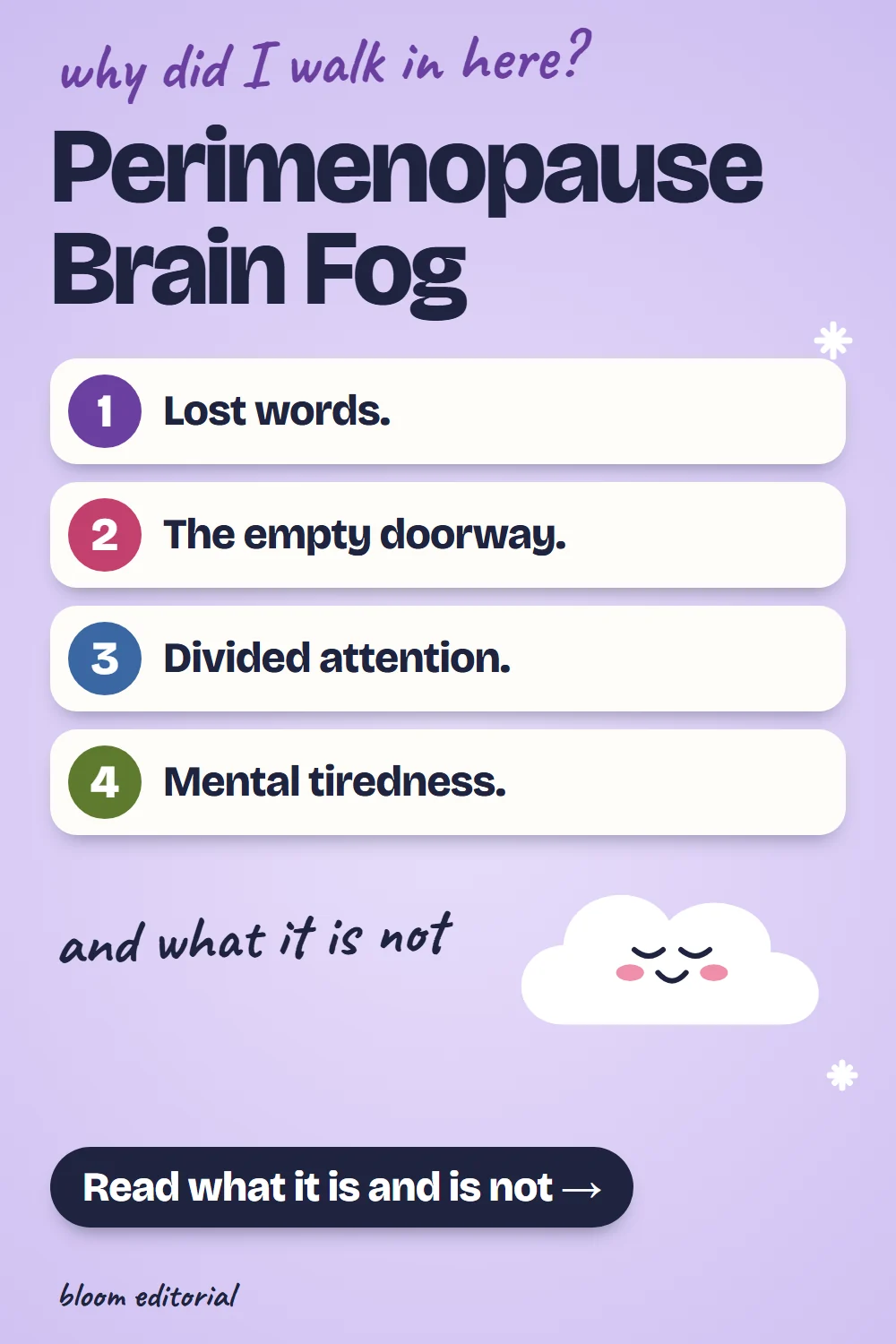
It can help to sort the fog into four shapes:
- Lost words. A name or a word you know well, gone mid-sentence.
- The empty doorway. Arriving somewhere with no idea why you came.
- Divided attention. Two things at once is suddenly one too many.
- Mental tiredness. Thinking feels slower and heavier, like working through static.
Picture Lena, 49, two months into a new job. She is a composite, drawn from many common experiences. In meetings, a colleague's name sometimes goes blank, and the embarrassment follows her around all day. You may have one shape or all four, and they can shift from week to week.
Why it is so frightening
A lost word is a small thing. What it seems to point toward is large, and many women carry that thought alone. The search tends to happen at midnight, which is why 3 a.m. anxiety in perimenopause has its own post.
Fear can also make it harder to think clearly, and then the next lapse feeds the fear. In one study of perimenopausal women, memory complaints went along with anxiety, depressive symptoms and disturbed sleep. They were tied to attention and working memory, and showed no link to verbal memory itself (Weber et al., 2012). That is an association in one group of women, and it cannot say which came first.
What may be going on
No blog post can tell you what is behind your fog. Here is what researchers describe in groups of women. The change seen most reliably during the transition is in learning and verbal memory. Planning and strategic thinking do not change in long-term studies. How much a woman is affected varies widely, it is nearly always mild, and average performance stays within normal limits (Maki & Jaff, 2022).
The same paper says that falling estradiol, hot flashes, disturbed sleep and mood all influence thinking at midlife. So the fog may have more than one contributor, and hormones are one possible explanation among several. On how long it lasts, the authors conclude that memory difficulties resolve in many women and persist in some.
What brain fog is not
It is no character flaw, and it is no measure of how hard you are trying.
The fear underneath usually has a name: dementia. The white paper states that the thinking changes of menopause should not be confused with dementia, and that dementia before age 64 is rare (Maki & Jaff, 2022). A guide for health professionals describes the difference this way (British Menopause Society, 2026). Brain fog is noticed mostly by the woman herself, can fluctuate, does not affect independent living and usually improves after menopause. Dementia is progressive, is noticed by other people, affects independence and is more common after 65.
Those are descriptions of patterns in groups of women. They cannot tell you which one you are living in, and neither can I. A doctor can. The same guide notes that brain fog is not always hormonal, and it lists other illnesses, nutritional deficiencies, mental health conditions, life circumstances, sleep and medication among the things to check.
When to talk to a doctor
None of these tells you what is going on. Each one is a reason to book an appointment soon, and a sudden change, or one that is getting worse quickly, is a reason to contact your doctor promptly or seek urgent care:
- A sudden change in your memory or thinking, or one that is getting worse quickly.
- Losing your way somewhere you know well. Whatever the reason turns out to be, it is worth having looked at.
- Trouble with everyday tasks you normally manage on your own.
- Someone close to you mentioning a change. It says nothing about the cause, and it is useful to bring to the visit.
- A worry that will not settle, whatever any list says.
That last one counts. Being worried is a legitimate reason to be checked. The practice below is meant to support professional care, and it does not replace it.
A practice for today: the Lapse List
Brain fog is slippery. When a doctor asks how often it happens, you honestly don't know. The Lapse List puts it on paper. Using something physical to take load off your memory has a name, cognitive offloading (Risko & Gilbert, 2016), which is a grand title for the back of an envelope. This week you are only watching the fog. One week of watching can tell you more than months of worrying.
One week of watching can tell you more than months of worrying.
Safety note: if writing about your lapses makes you more anxious, keep entries to three words or fewer. This is a noticing tool. You can stop at any time.
Setup: keep the list where you can reach it within 30 seconds. A small notebook, a sticky note on your desk or the back of an envelope all work. Run it for seven days. Each entry takes a few seconds.
- Write 3 to 5 words. Do it within a minute or two of the lapse: "Lost name in meeting." "Keys in fridge." Speed beats detail.
- Add what you did next. "Paused, it came back." "Retraced steps." "Asked a colleague." This is noticing that you recovered.
- Add a context if you notice one. Tired, bad night, stressful morning. If nothing stands out, leave it blank. Never force a reason.
- Glance at the list at the end of each day. No analysis. Close it and move on.
- Read the whole list after seven days. See whether lapses cluster at a time of day, after a kind of night or in certain situations. Write down what you notice.
If seven days feels like too much, start with three. If the list gets long, keep only the two or three biggest lapses of the day.
The Lapse List is Tool 01a in Chapter 1 of The Perimenopause Brain Fog Workbook. The paperback prints a seven-day Lapse List log to fill in, and the chapter adds the Lapse Tally for tired days. Later chapters turn the list into a 14-day map (Chapter 2), build paper backups for your memory (Chapter 4) and a one-page summary for your doctor (Chapter 7).
What you might notice
Relief, because written down it often feels smaller than it did in your head. Surprise: there may be fewer lapses than you feared, or they may cluster in ways you did not expect. A flicker of shame, which is common.
You might also notice nothing: no pattern, and no feeling either way. That is information too. If the list starts to feed the worry, shorten the entries, drop to three days or put it away.
When to use it
- The week before a doctor's appointment. "I lost words in conversations four times this week, mostly in the afternoon" gives a doctor far more to work with than "I've been forgetting things."
- When the worry is loudest. A short list can be easier to look at than a feeling.
- After a run of bad nights, to see whether the fog follows them.
For the day to day, these brain fog memory tips put a few paper backups in place.
Questions women ask about perimenopause brain fog
What does perimenopause brain fog feel like? Mostly small and ordinary: a word you know well gone mid-sentence, arriving in a room with no idea why you came, two things at once suddenly being one too many, thinking that feels slower and heavier. You may have one of these or all four, and they can shift from week to week.
How long does perimenopause brain fog last? It varies, and no one can give you a date. The authors of the International Menopause Society white paper conclude that memory difficulties resolve in many women and persist in some (Maki & Jaff, 2022). For your own fog, a doctor is the person to ask.
When should I see a doctor about brain fog? Contact your doctor promptly, or seek urgent care, if a change in your memory or thinking is sudden or getting worse quickly. Book an appointment soon if you have trouble with everyday tasks you normally manage on your own. A worry that will not settle is also a legitimate reason to be checked. Brain fog is not always hormonal, and a doctor can look at the other things worth checking (British Menopause Society, 2026).
Worry about memory and anxiety can feed each other, and a lost word is harder to wait for when your heart is racing. When the worry comes on fast, the physiological sigh takes a minute or two. The rest of the method for the fog is in The Perimenopause Brain Fog Workbook. If the anxiety is the louder part, my Perimenopause Anxiety Workbook is a separate book for that. For today, an envelope and a pen are enough to begin.