
Some wounds don't bleed. They just settle in.
They live somewhere below the ribs, quiet and heavy, and after enough years you almost stop noticing them. You still bring the casserole and bow your head during the slow songs. From the outside, you look fine.
But at night, when the house is finally still, something you have no name for sits down beside you.
If that is you, you have not failed at faith. You were never shown how to lament.
Lament is honest speech to God about what hurts. The Bible is full of it, and one short passage in Lamentations shows its whole shape. Below is that passage, then a prayer of lament you can write this week in about twenty minutes.
Bandages too small for the wound
"Just trust God." "Count it all joy" (James 1:2, KJV). We reach for words like these the moment the ache surfaces. The words are true. They are being pressed against a wound that hasn't been cleaned yet.
Somewhere along the way, many of us decided that admitting we still hurt, especially about something old, was an accusation against God's faithfulness. So we performed healed. We mistook silence for healing, and performance for peace.
What the poet does first
Lamentations is a book of grief over the fall of Jerusalem. The city had been burned and its people carried into exile. In the middle of that grief, the poet writes:
"Remembering mine affliction and my misery, the wormwood and the gall. My soul hath them still in remembrance, and is humbled in me. This I recall to my mind, therefore have I hope. It is of the LORD's mercies that we are not consumed, because his compassions fail not. They are new every morning: great is thy faithfulness." (Lamentations 3:19-23, KJV)
Read it slowly and notice the order. Before "great is thy faithfulness," he names it all: affliction, misery, wormwood, gall. His soul is humbled in him, and he says so. Hope appears only after the naming.
How to lament in four movements
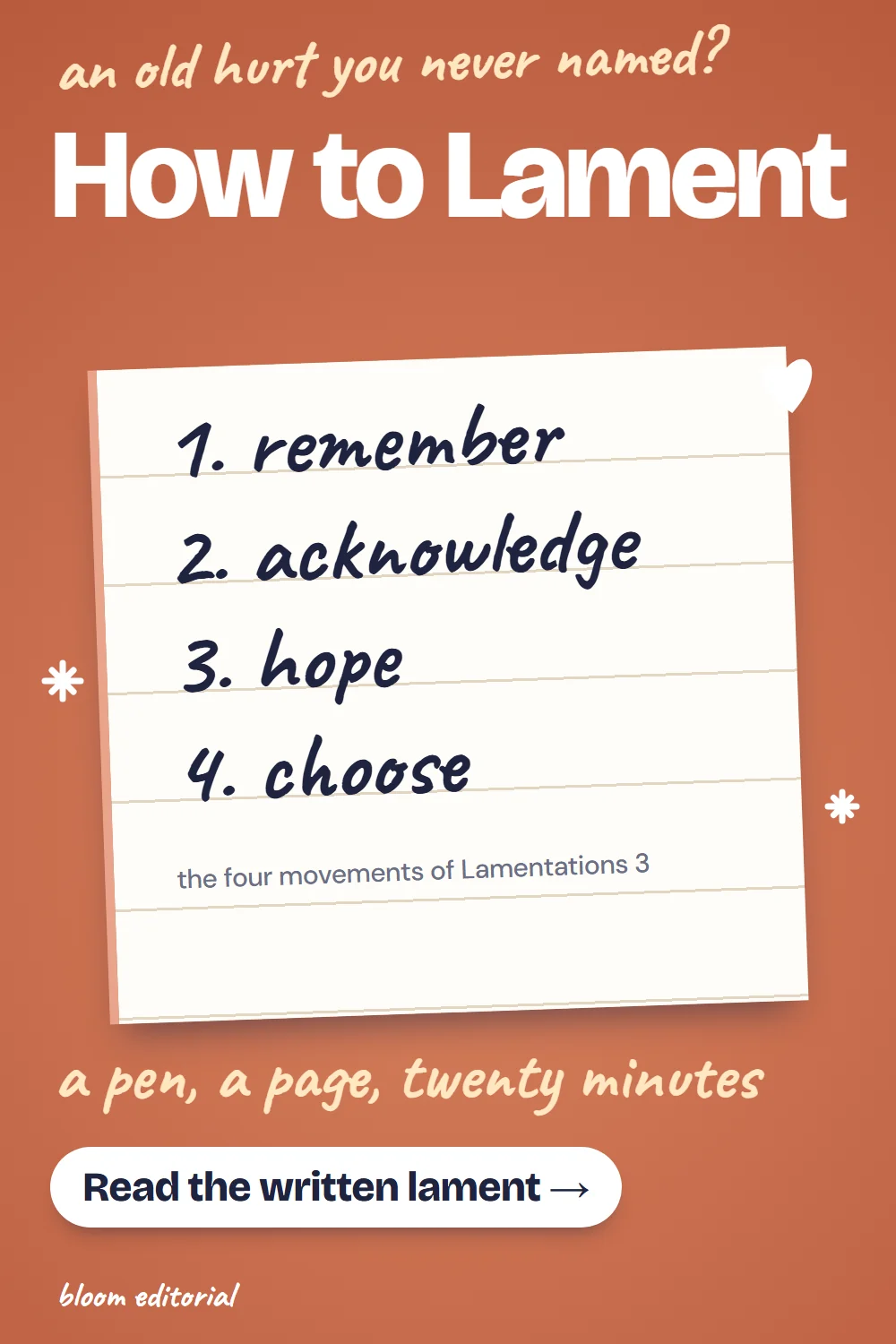
That is the shape of lament, in four movements. Each has its own line in the passage.
- Remember. "Remembering mine affliction and my misery." Let the wound be real, without minimizing it.
- Acknowledge. "...and is humbled in me." Name what it has done to you on the inside.
- Hope. "This I recall to my mind, therefore have I hope." Hope here is something he calls back to mind on purpose, before he feels it.
- Choose. "Great is thy faithfulness." He says one true thing about who God is while the rubble is still around him.
Picture a woman I'll call Carolyn. She is a composite, drawn from what many women describe. She sits with her pen over a blank page for ten minutes, thinking: my thing isn't bad enough. Other women have it so much worse. Who am I to lament? Then she writes the sentence she has never said out loud, that her marriage has felt empty for four years. Nothing dramatic by anyone else's scale, and it has been sitting below her ribs all that time. Your wound doesn't have to be the worst wound in the room to deserve a name.
Your wound doesn't have to be the worst wound in the room to deserve a name.
Even Jesus, standing at the tomb of His friend Lazarus and knowing what He was about to do, did not hurry past the grief. "Jesus wept." (John 11:35, KJV) Grief and faith can live in the same heart. You do not have to be okay before you come to God with your wound. You just have to come.
A prayer of lament to write this week
This is the written lament from Chapter 1 of the book. Give yourself at least twenty minutes without interruption, a pen and a page. Prayer requests and gratitude lists can wait for another day. This is honest speech, addressed directly to God, about what you are carrying right now. Work through each movement in order. There is no right way to do it.
- Pause for sixty seconds. Place your hand on your chest and ask God one question: What am I not saying? Notice what surfaces.
- Remember. Begin with "I remember..." Describe the wound, the loss, the betrayal or the grief. Name it as specifically as you can. What happened? What did it cost you?
- Acknowledge. Begin with "And my soul is humbled in me because..." Write how it has settled inside you. What do you feel, and where do you feel it? What have you stopped believing because of it?
- Let it stand. Read what you wrote once, and leave it as it is. If you feel the pull to add "but I'm grateful for..." right away, wait.
- Hope. Begin with "This I recall to my mind..." You are not required to feel hopeful when you write this. Write what you know to be true about God, even now. It can be small, just one thing.
- Choose. Begin with "Today I choose to believe..." Declare one specific truth about God's character, and leave your circumstances out of the sentence.
A fear often comes up here: if I open this door, the grief will sweep me away. Naming is a smaller act than that. You are giving the wound a word or a sentence.
And if the page stays blank, or twenty minutes is more than today allows, write one sentence and stop: "Lord, I am carrying ______, and I have been carrying it since ______, and I have been afraid to bring it to You because ______."
That is the beginning of a lament. And it is holy ground.
The book takes this lament further. Chapter 1 of Healing Bible Study for Women adds a second exercise for finding the true name of what you have been calling stress or a hard season, five reflection questions and a closing prayer written in full. Five more chapters follow, one for each week.
What you might notice
Tears, sometimes. The kind that have been waiting a long time. You can let them come, and you can set the pen down until they pass.
You might feel lighter afterward, or simply tired. You might also notice nothing. The words may look flat on the page, and the third movement may not come at all. Scripture has room for that. Psalm 88 is a prayer that never arrives at praise. Its last line is "and mine acquaintance into darkness" (Psalm 88:18, KJV), and it was kept in the Bible just as it stands. If hope will not come today, stop after the second movement and return another day. An unfinished lament is still a prayer.
Writing a lament is no guarantee that the wound will close, and a wound that stays open says nothing about the size of your faith. If the pain is deep, or has been with you for a long time, it can also deserve the help of a pastor, a counselor or a doctor. Asking for that help is one more way of naming it.
When to use it
- When the numbness settles in. Do only the first step: sixty seconds, a hand on your chest, one question.
- When you hear yourself say "I'm good, just busy." Take the full twenty minutes that evening, with all four movements.
- When an old grief comes back. The book calls this pattern a rhythm. Women return to it again and again, sometimes for the same wound at a different depth.
If you would like a structure to keep going, here is how to begin a Bible study for women who are hurting.
Questions women ask about how to lament
What is a prayer of lament? A prayer of lament is honest speech to God about what hurts. Lamentations 3:19-23 shows its shape in four movements: remember, acknowledge, hope and choose. The naming comes first, and hope appears only after it.
How do you write a lament? Give yourself at least twenty minutes, a pen and a page, and address God directly. Begin with "I remember..." and work through the four movements in order. If that is more than today allows, write one sentence about what you are carrying and stop.
Is lament a lack of faith? No. The poet of Lamentations names his affliction and his misery before he says a word about God's faithfulness, and Jesus did not hurry past the grief at the tomb of Lazarus (John 11:35). Grief and faith can live in the same heart.
When prayer itself has gone quiet and you are tired of asking, The God Who Heals at Bitter Water is the next reflection to sit with.
And on the ordinary days, when the trouble is a blank page more than an old wound, these prayer journal ideas give you a first line to borrow.
The book is a six-week Bible study for women, and this lament is where it begins. Its pages give you lined space for each movement.
This reflection comes from Chapter 1 of Healing Bible Study for Women by Hannah Grace. Scripture quotations are from the King James Version.