

It's 2:40 on a Wednesday afternoon. You have read the same email three times, and the name of the colleague you're answering has left the building. Yesterday you were sharp. Tomorrow could go either way.
That is the maddening part of menopause brain fog. It seems to keep no schedule: a good Tuesday, a useless Wednesday, a fine Thursday. Random is hard to live with, because you can't plan around it and you can't explain it to anyone.
It may be less random than it looks. This entry gives you one small practice, a two-week map of when the fog shows up, how strong it is and what it travels with. You need a notebook, a pen and about 90 seconds a day.
Why menopause brain fog is worth mapping
I've written separately about what perimenopause brain fog is and what it isn't, so I won't repeat it here. For the map, one finding matters. A review written for the International Menopause Society names hot flashes, disturbed sleep and mood among the things that influence thinking at midlife (Maki & Jaff, 2022).
A review describes groups of women. It can't say which of those things, if any, is tangled up with your foggy Wednesdays. A map shows patterns. It doesn't diagnose anything, and it can't settle what causes what. What it can do is turn "I keep forgetting things" into a page you can look at.
When to talk to your doctor first
Some changes shouldn't wait for two weeks of notes. Contact your doctor promptly, or seek urgent care, if a change is sudden or getting worse quickly. Talk to your doctor soon if you are getting lost in places you know well or having trouble with everyday tasks you used to do without thinking. Brain fog can have more than one explanation, and a doctor is the person who can sort through them with you. The map below is meant to support professional care, and it does not replace it.
Set up your 14-day fog map
Open a notebook and rule six columns and fourteen rows, one row per day. Head the columns Clarity, Sleep, Night sweats, Stress, Cycle day and Lapses. Leave a margin for one or two words about the day, such as "deadline" or "good sleep." It is the closest thing to a brain fog tracker you can make with a ruler.
The last column uses four letters, shorthand for the common shapes of fog:
- W for a lost word: a name or a word you know well, gone mid-sentence.
- D for the empty doorway: arriving somewhere with no idea why you came.
- A for divided attention: two things at once is suddenly one too many.
- T for mental tiredness: thinking feels slower and heavier.
The morning check-in, step by step
Do this once a day for 14 days, before you pick up your phone. It takes about 90 seconds.
- Close your eyes for five seconds. Find one honest word for how your head feels this morning.
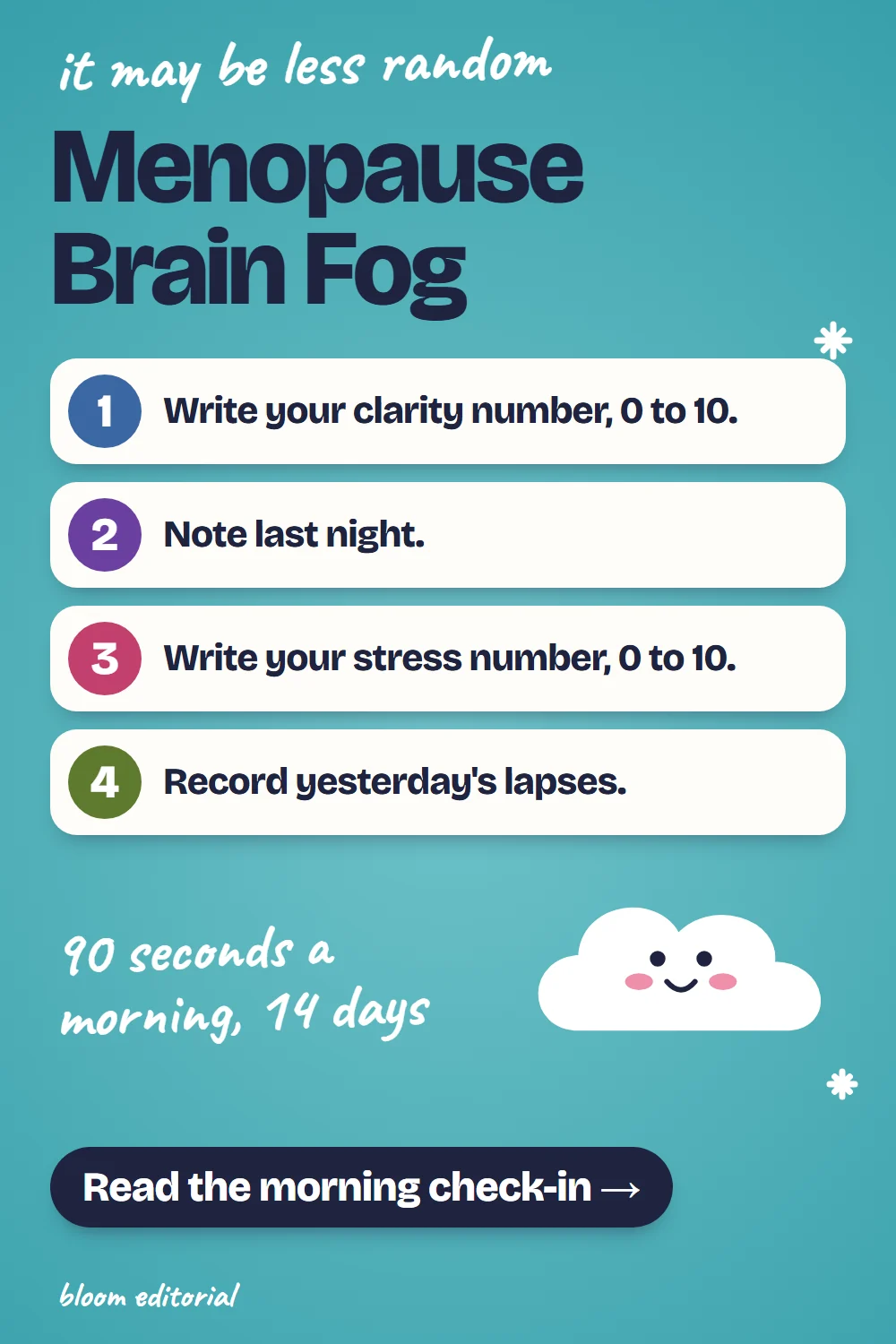
- Write your clarity number, 0 to 10. 0 is "I can barely form a sentence." 10 is "sharp and focused." Most days land in the middle. The first number that comes to mind wins.
- Note last night. Write roughly how many hours you slept, whether the sleep was broken, and yes or no for night sweats or hot flashes overnight.
- Write your stress number, 0 to 10. It stands for how much pressure you are carrying.
- Add your cycle day, if you still track it. Otherwise write "irregular" or leave it blank.
- Record yesterday's lapses. Write W, D, A or T, whichever applied. One letter, two or none.
A finished row might read: clarity 3, five hours, broken, night sweats yes, stress 6, irregular, W and T. No sentences required.
On a day when even that is too much, write only the clarity number. One number keeps the map going. And try not to analyze as you go. The reading comes after day 14.
You will miss a day at some point. Leave the row empty and pick up at the next one. Nothing resets, and there is no perfect run to protect. An empty row tells you something too: if the gaps bunch together, look at what was happening that week, because the gap can be part of the pattern. A rough map with honest numbers beats a perfect log you abandoned on day four.
A rough map with honest numbers beats a perfect log you abandoned on day four.
How to read your map after day 14
Set aside about 10 minutes. You are looking for a cluster, meaning low clarity that tends to show up alongside something else.
- Circle your lowest days. Mark every day with a clarity score of 4 or below.
- Look at what came before. For each circled day, check the night before and the day before for broken sleep, night sweats, stress of 7 or more, or a certain point in your cycle.
- Look for the repeat. See whether the same thing shows up before most of your low days. It doesn't have to be every time.
- Notice your best days too. Write down what your clearest days have in common. Good days are as informative as hard ones.
Then count which lapse letter showed up most, and whether it keeps company with anything in the other columns.
This map is the Morning Check-In, Tool 02a in Chapter 2 of The Perimenopause Brain Fog Workbook. The paperback prints the 14-day log as two weekly pages, plus a four-week fog calendar to shade. The chapter ends with a guided pattern reading, and other chapters cover what else can cause fog, paper backups, the fog multipliers (sleep, night sweats and stress) and your doctor's visit.
What you might notice
Picture Renée, 51, an accountant who works from home. She is a composite of many women, and she was sure her fog was random. By day ten her page said otherwise: her worst days almost always followed the nights she woke up drenched.
Other maps look different. One woman's hardest days may line up with her highest stress scores and have little to do with sleep. Another may need both at once, broken sleep plus a heavy workload, before the fog gets bad. No pattern is the "right" one.
You might also find no pattern at all. That is information too. It may mean you need a longer window, and it never means you did it wrong.
If the map makes you more anxious, drop back to the one clarity number, or put it away. If something you notice feels sudden, very different or frightening, stop and call your doctor.
When to use it
- When the fog feels random and you have started to dread it.
- In the two weeks before a doctor's visit, so you arrive with a page of notes.
- For another two weeks later on, if the first map showed nothing obvious or your days have changed.
What to do with your fog map
The map has three jobs. The first is knowing what a foggy day is about. A low score after a night of hot-flash wake-ups can become this may be what last night cost me, which is easier to carry than what is wrong with my brain? If your map keeps pointing at the nights, and the nights include lying awake with a racing heart, I've written about 3 a.m. anxiety in perimenopause as well.
The second job is choosing one thing to work on, and leaving the rest alone for now. The map can suggest which one is most likely to matter for you.
The third is the doctor's visit. Bring the notebook. You could say: "I've tracked my brain fog for two weeks and I see a pattern around sleep and night sweats. Can we talk about that, and about whether anything else should be checked?"
When your map is ready, here is how to talk to your doctor about brain fog, with a one-page summary to bring.
Questions women ask about tracking menopause brain fog
How do I track menopause brain fog? One row a day in a notebook for 14 days: a clarity number from 0 to 10, last night's sleep, night sweats, a stress number, your cycle day and yesterday's lapses. It takes about 90 seconds each morning, before you pick up your phone. On a hard day, the clarity number alone keeps the map going.
Why is menopause brain fog worse on some days than others? No blog post can tell you that about yours. A review written for the International Menopause Society names hot flashes, disturbed sleep and mood among the things that influence thinking at midlife (Maki & Jaff, 2022). A two-week map can show what your low days tend to follow, though it shows patterns and can't settle what causes what.
What should I tell my doctor about brain fog? Bring the notebook, say what you tracked and what pattern you see, and ask whether anything else should be checked. Don't wait for two weeks of notes if a change is sudden or getting worse quickly, or if everyday tasks have become hard. Brain fog can have more than one explanation, and a doctor is the person who can sort through them with you.
The full map, with its log pages printed in the paperback, is in The Perimenopause Brain Fog Workbook. If your low days keep pointing at stress that feels more like anxiety than workload, my Perimenopause Anxiety Workbook is a separate book for that. For today, a notebook and tomorrow morning's first number are enough to begin.