

It's 3 a.m. Your heart is hammering. You're lying in the dark, running through every possible reason: the 2 p.m. coffee, the odd email from your boss, something you said to your sister three weeks ago.
You are exhausted. Your mind will not stop.
By morning you've reached the usual verdict: something is wrong with me. Maybe you've even been told it's stress, and that you should try to worry less. (Helpful.)
3 a.m. anxiety in perimenopause is something many women describe. No blog post can tell you what is causing yours. What this one can do is lay out what researchers have looked at so far, and give you one complete thing to do in bed tonight.
What may be going on with 3 a.m. anxiety in perimenopause
In perimenopause, estrogen doesn't decline in a tidy straight line. One endocrinologist describes estradiol in these years as erratic and, on average, higher than before, with progesterone running lower (Prior, 2002). Think less of a slow fade and more of a dimmer switch operated by a toddler.
Progesterone matters for a reason most women never hear. Your body turns some of it into a compound called allopregnanolone. A research review describes allopregnanolone as strengthening the effect of GABA, a chemical messenger that quiets nerve activity (Barth et al., 2015). Whether lower progesterone means less of that quieting for you, on a given night, is more than the review can tell either of us.
Then there is how the body meets stress. In a small pilot study, 15 perimenopausal women were followed for 12 weeks. The women whose estrogen marker fluctuated more had a higher heart rate during a lab stress test and reported more rejection, anger and sadness. The fluctuation was not linked to their cortisol or blood pressure (Gordon et al., 2019). That is a very small group, and a lab is a long way from your bedroom.
Sleep changes too. A 2018 review of sleep in the menopause transition tied sleep trouble to menopausal stage and hormone changes beyond age alone, and named hot flashes as a major contributor, many of them linked to awakenings (Baker et al., 2018).
Put together, these are findings about groups of women, and they can't say what is happening in your body. They do offer a kinder reading of a bad night. Your nights may have more to do with shifting hormones than with how well you cope.
Your nights may have more to do with shifting hormones than with how well you cope.
When to talk to a doctor
New or worsening palpitations, chest pain, shortness of breath, or anxiety that is getting in the way of your daily life are reasons to talk to a doctor. Sudden or severe chest pain is a reason to call for emergency help. Hormones are one possible explanation among several, and a doctor is the person who can sort through them with you. The practice below is meant to support professional care, and it does not replace it.
What to do in bed at 3 a.m.: tense and release
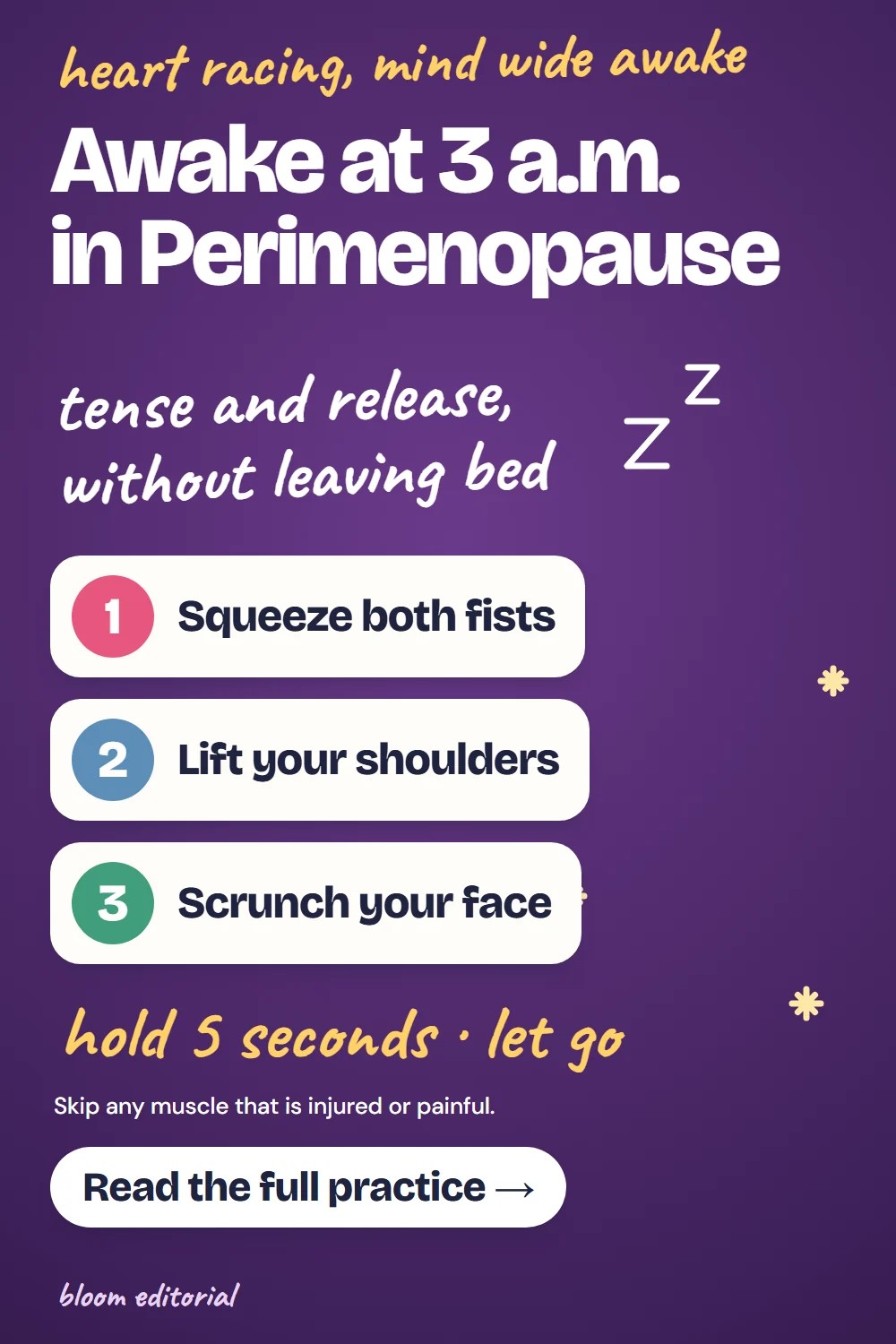
The practice is called progressive muscle relaxation. You tense one muscle group for 5 seconds, let it go completely, and move on to the next. It needs no light, no phone and no getting out of bed.
It has been tested in women near this stage of life. In a 2024 randomized trial, 63 postmenopausal women with poor sleep quality took part. Those who practiced it every day for eight weeks improved in sleep quality and fatigue (Sucu & Çitil, 2024). Two caveats: those women were past menopause, and the trial did not measure anxiety. So take this as something that may help your body settle. It comes with no promise of sleep.
Safety note: if you have an injury, recent surgery or chronic pain in any muscle group, skip that group and move to the next. Tension should be firm but never painful. If something hurts, release immediately.
Lie on your back with your arms at your sides. The workbook sets aside about 10 minutes for the full round, which leaves you room to move slowly. After each of the 8 muscle groups, rest for about 10 seconds before the next one.
- Hands and forearms. Squeeze both fists tightly. Hold for 5 seconds. Release completely, and feel the warmth and heaviness in your hands.
- Upper arms. Bend your elbows and flex your biceps, like a slow bicep curl. Hold for 5 seconds. Release, and let your arms drop heavy.
- Shoulders. Lift both shoulders up toward your ears. Hold for 5 seconds. Release, and let them drop as far as they go.
- Face and jaw. Scrunch your entire face: eyes, nose, jaw, forehead. Hold for 5 seconds. Release, and notice the muscles around your eyes and jaw softening.
- Neck. Press the back of your head gently into the pillow. Hold for 5 seconds. Release. Do not strain, and skip this step if you feel any sharp sensation.
- Chest and upper back. Take a deep breath in and hold it while you press your shoulder blades together. Hold for 5 seconds. Exhale and release.
- Abdomen. Draw your belly in toward your spine. Hold for 5 seconds. Release completely, and let your belly go soft.
- Legs and feet. Flex both feet, point your toes upward, and tighten your thighs and calves at the same time. Hold for 5 seconds. Release, and let your legs sink into the mattress.
To close, lie quietly for 60 seconds and breathe normally. Scan slowly from your feet to your face and notice what's different.
If 10 minutes sounds impossible while you're this wound up, do three groups only: hands, shoulders and face.
Tense and release is the last of four tools in Chapter 3 of the Perimenopause Anxiety Workbook. What the book adds to this page: three faster tools for the moments that can't wait ten minutes, and a planner where you choose, in daylight, which one will be your 3 a.m. tool.
What you might notice
Heaviness in your hands, your legs or your whole body. Warmth in a muscle just after you let it go. A sigh, a few tears or even a laugh, which is a strange thing to produce in a dark bedroom and is fine. You might fall asleep before step 8, which is allowed.
You might also notice nothing. That's common the first few times, and it doesn't mean you did it wrong.
If tensing leaves you more keyed up, or a muscle cramps, stop and breathe normally. Try the three-group version another night, or set this practice aside.
When to use it
- At 3 a.m., when you're awake with a racing heart and a body that won't let go. Reach for your fists before you reach for your phone.
- In the hour before bed, after a day of building tension.
- In the morning, when you need a reset before the day starts.
This is a slow tool. When anxiety arrives fast and you want something that takes a minute or two, the physiological sigh is a better fit. And if you'd like a breathing practice for bedtime itself, Maya Chen's evening extended exhale is a gentle place to start.
And if broken nights are followed by foggy days, a notebook can show whether the two travel together: here is how to map menopause brain fog over 14 days.
A daytime follow-up: start your own record
The middle of the night is a poor time for analysis. In daylight, with a notebook, try these questions.
- When did you first notice this anxiety, or notice it getting worse? A rough age or year is fine.
- Does it follow any pattern in your cycle, or does it seem random?
- What does it feel like in your body, before any thought shows up?
There's no right answer. You're drawing the first lines of a map, and it gives you something concrete to bring to your next doctor's visit.
Questions women ask about 3 a.m. anxiety in perimenopause
Why do I wake up at 3 a.m. with anxiety in perimenopause? No blog post can tell you what is causing yours. Researchers have looked at estrogen that swings while progesterone runs lower, at how the body meets stress, and at hot flashes that come with awakenings. Those are findings about groups of women, and hormones are one possible explanation among several.
Is a racing heart at 3 a.m. a perimenopause symptom? Many women in perimenopause describe it, and it still isn't something to assume. New or worsening palpitations, chest pain or shortness of breath are reasons to talk to a doctor, and sudden or severe chest pain is a reason to call for emergency help.
What can I do when I wake up anxious at 3 a.m.? One option is progressive muscle relaxation, done lying in bed: tense one muscle group for 5 seconds, let it go, and move to the next. It may help your body settle, and it comes with no promise of sleep. If the full round is too much, do hands, shoulders and face only.
These questions and the muscle relaxation practice both come from my book, The Perimenopause Anxiety Workbook, which has the seated version and three other calming tools. For tonight, two fists and a count of five are enough to begin.