The notebook has been on your nightstand for three weeks. You saw photos of other women's pages, the neat handwriting and the verse in soft ink, and you thought you could do that. Then you opened it and did not know which verse to choose, or what you were supposed to write after you copied it.
This is scripture writing for beginners, starting from the first page. You copy one short Bible verse by hand, word for word, and then you spend a few minutes with it on paper. That second part is where most of us get stuck, so here are three simple ways to do it and one full first session you can try tonight.
What is scripture writing?
Scripture writing is copying a passage of the Bible by hand, slowly, in the exact words of the translation you are using. It is not a commentary study, and it is not art journaling, though you can add color later if you like. One verse, one pen and one honest response are enough to count.
One verse, one pen and one honest response are enough to count.
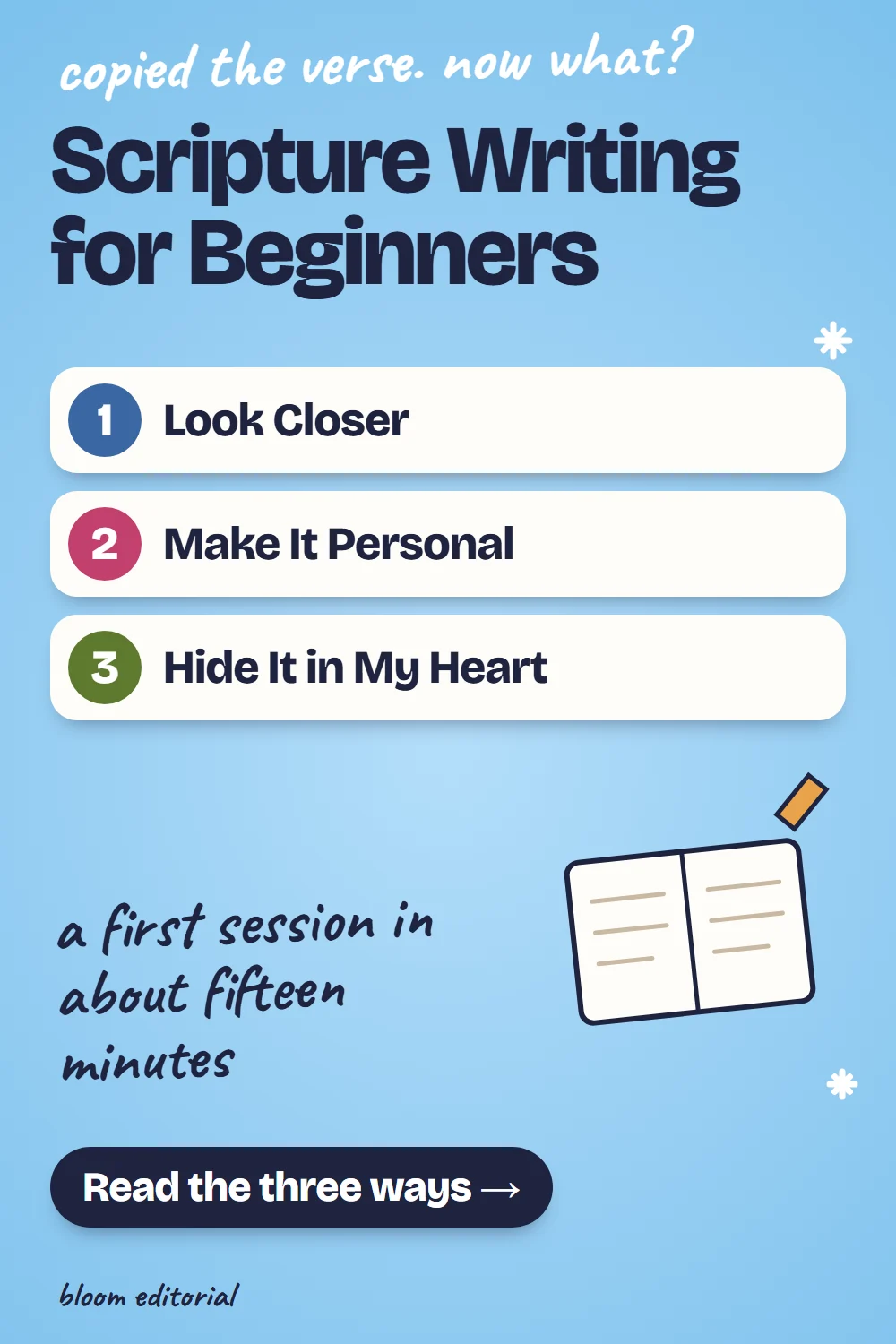
The simplest shape I know comes from my Scripture Journal for Women, where every passage gets two pages. On the first you write it out. On the second you reflect, and the reflection pages take turns among three kinds: Look Closer, Make It Personal and Hide It in My Heart. A beginner does not need all three at once. Pick one reflection for each verse, and let the next verse take the next one.
Every verse below is from the King James Version. Its words are old, and copying them exactly is part of the work.
Scripture writing for beginners: three ways to reflect
Here is what each reflection page asks, with passages from the first part of the journal, Who God Is, as examples.
Look Closer. This page is for noticing. You write the word or phrase that stopped you, then what it shows you about God. It also asks you to pray the verse back in your own words and to name one way to live it today. In the journal, Psalm 90:2 gets this page: "Before the mountains were brought forth, or ever thou hadst formed the earth and the world, even from everlasting to everlasting, thou art God." (Psalm 90:2, KJV) Its question asks what feels urgent in your life this week that looks different next to an everlasting God.
Make It Personal. This page is for translating. You rewrite the passage the way you would say it to a friend, then write where you need it right now, and finish with a short prayer. Isaiah 40:28 gets this page, and it suits a long KJV sentence well: "Hast thou not known? hast thou not heard, that the everlasting God, the LORD, the Creator of the ends of the earth, fainteth not, neither is weary? there is no searching of his understanding." (Isaiah 40:28, KJV) The question beside it: where have I been assuming God is as tired of my struggles as I am?
Hide It in My Heart. This page is for remembering. You cover the verse and write it again from memory. The page says it plainly: peek if you need to, memory grows by trying. Then it asks who might need to hear this verse, and leaves a line that begins Lord, help me. The first session below uses this page.
How to do scripture writing: your first session
What you need: a King James Bible or the verse printed out, a pen, and any lined notebook. How long: about fifteen minutes. If you only have five, do steps 1 to 3 and stop. The reflection can wait.
The verse is Psalm 103:8. It is thirteen words long, a good size for a first time: "The LORD is merciful and gracious, slow to anger, and plenteous in mercy." (Psalm 103:8, KJV)
- Read the verse aloud once. Slowly, all the way to the last word, before you pick up the pen.
- Copy it word for word. Keep LORD in capitals and keep "plenteous." Do not tidy the old words into new ones.
- Check your copy against the Bible. Go word by word with your finger. If you dropped an "and," fix it. This is where the small words start to show up.
- Cover both and write it again from memory. Peek if you need to. Memory grows by trying.
- Answer one question in three or four sentences. The journal asks of this verse: how does a God who is slow to anger change the way I come to Him after I fail?
- Write one name. Under "Who might need to hear this?" put the first person who comes to mind. You do not have to send it to anyone.
- Close with one line that begins "Lord, help me." Finish it honestly, then shut the notebook.
In Scripture Journal for Women, Psalm 103:8 is passage 5 of 96. It is printed at the top of a lined page, so there is nothing to look up, and the page after it is a Hide It in My Heart reflection with that question already written. All 96 KJV passages work the same way, each with its own question and the three reflection pages taking turns. What the journal adds is the rest of the method: twelve parts, each with a short introduction and a checklist of its eight passages; one creative practice in every part, starting with a map of God's name in Exodus 34:6; a Looking Back page at the end of each part; and a tracker with 96 squares to shade. A plain notebook will hold this first session just as well.
What you might notice
You might notice a word you have read past before. "Plenteous" is an unusual word to write by hand, and your pen may slow down on it. You might notice that step 4 is harder than you expected. Or you might notice nothing at all.
Nothing is an honest result. The verse is on the page in your handwriting either way, and the next session does not depend on how this one felt.
Some verses touch tender places. If a question opens something painful, you can copy the verse and leave the rest for another day. If the heaviness does not lift by the end of the day, set the page aside and talk to someone you trust: a friend, your pastor or a counselor.
When to use this first session
- The first time you try scripture writing. Use Psalm 103:8 and the seven steps as written.
- Before you choose a plan. A session or two shows you what pace you can keep: one verse a day, a few each week, or one every Sunday afternoon.
- After a long gap. If weeks have gone by, start again with one short verse and steps 1 to 3. Nothing resets.
Common beginner mistakes
- Choosing a plan with dates and falling behind. The journal has no dates on purpose, so you can't fall behind. If you miss a day, skip it and keep going.
- Thinking a session without reflection does not count. If you only have five minutes, just write the verse.
- Modernizing the words. Copy word for word, old verb endings included. Changing "fainteth" to "faints" turns copying into paraphrase, and Make It Personal is the page for your own words.
- Refusing to peek. Writing from memory is not a test. Peek if you need to.
- Pushing through a heavy page. Every question is an invitation, not an assignment. You can skip it, change it or stop halfway.
Where to go after your first session
Once a few sessions feel natural, a plan saves you from choosing the next verse. The December scripture writing plan takes eight KJV passages on peace across four weeks, two a week, with rest days. The 2027 scripture writing plan sets twelve themes across the year, one a month. And if your "Lord, help me" line keeps growing into a page, these prayer journal ideas for when you don't know what to say show how to begin a prayer journal.
Questions women ask about scripture writing for beginners
What is scripture writing? It is copying a Bible passage by hand, word for word, in the translation you are using, and then responding to it on paper. In this method, every verse gets a written copy and one reflection: Look Closer, Make It Personal or Hide It in My Heart.
How long should a beginner spend on scripture writing? About fifteen minutes for the full first session above. On a five-minute day, read the verse, copy it and check it. The reflection can wait.
Do I have to memorize the verse? No. Writing from memory is one of the three reflection pages, not a requirement for every verse. When you do try it, peek if you need to, because memory grows by trying.
The notebook on the nightstand needs only one verse to stop being blank. Psalm 103:8 is thirteen words.
This method comes from Scripture Journal for Women by Hannah Grace. Scripture quotations are from the King James Version.