

The notebook is open on the kitchen table. The coffee beside it is going cold. You wrote the date at the top of the page ten minutes ago, and you have written nothing since.
If you went looking for prayer journal ideas because you love the thought of writing your prayers and have no notion what belongs on the first line, you are in good company. The journal these ideas come from says it plainly: "Most of us were never taught how to pray."
Below is how one week of that journal is laid out, six ideas from its pages, and a ten-minute practice you can do today on any sheet of paper.
How to start a prayer journal: borrow a shape
A blank page asks you to invent a prayer from nothing. A shape gives you a first line. In Daily Prayer Journal for Women, every week has four pages:
- The week opener. A verse from the King James Version, a short reflection, a prayer to begin, and a practice that grows out of that week's verse.
- Days 1 to 3 and Days 4 to 6. Three short daily entries per page. You write the date and fill in as much as you want.
- Day 7, Looking Back. Two reflection questions written for that week's verse, plus space for answered prayers and what you are carrying forward.
The journal runs fifty-two weeks, in four parts of thirteen weeks each, and it is undated. In the first part, Coming Near, every daily entry has the same four lines: "Lord, I praise You for," "What I'm laying down today," "What I'm asking You for," and "Thank You for." In the book's words, that order "keeps prayer from becoming only a list of requests."
Six prayer journal ideas from the first thirteen weeks
Each week's practice is different. These six come from Part One, and each works with a pen and a plain page. Use them as prayer journal prompts on the days your own words run out.
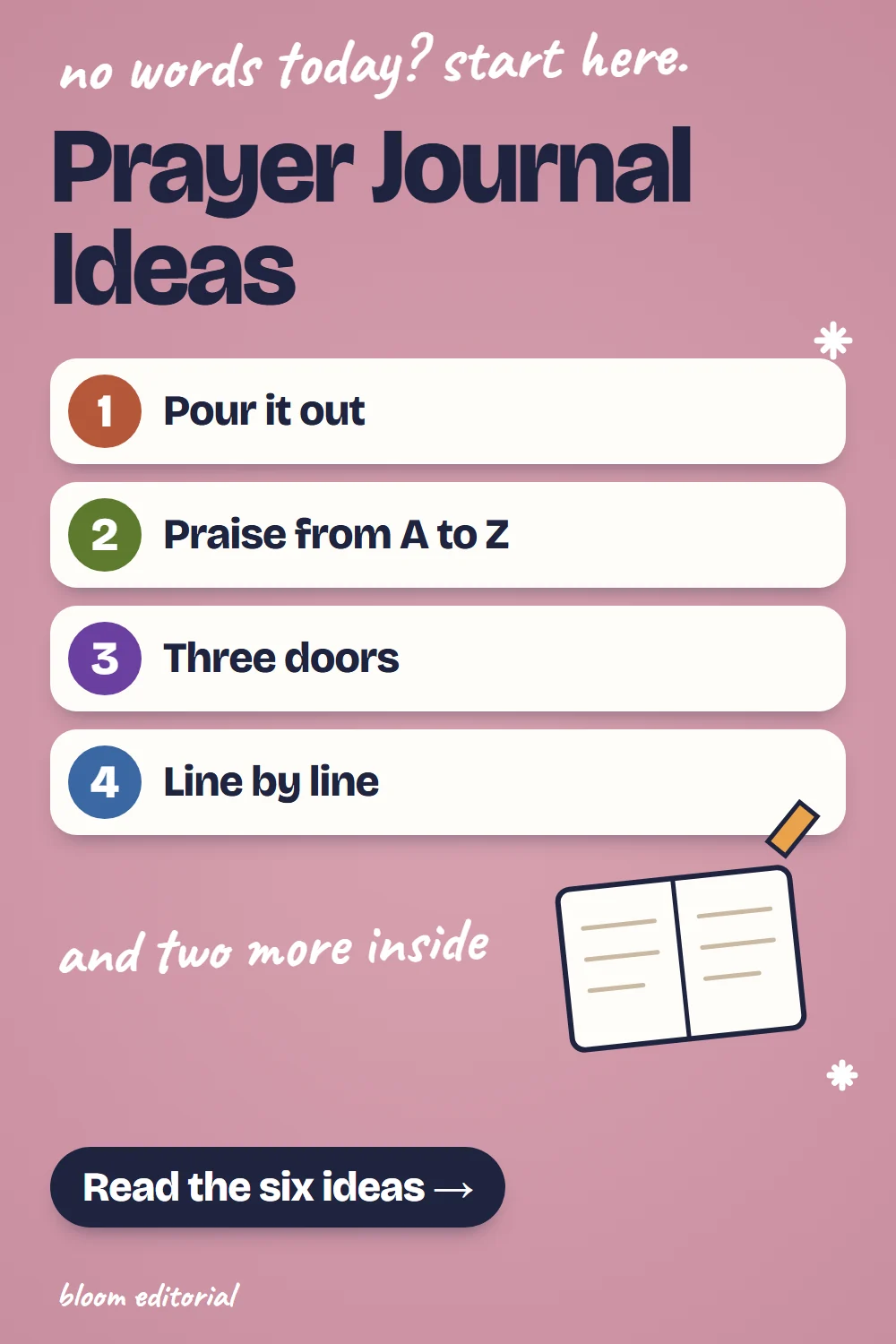
- Pour it out (Week 2). The verse is "Trust in him at all times; ye people, pour out your heart before him: God is a refuge for us. Selah." (Psalm 62:8, KJV) The page shows a pitcher and gives one instruction: "Write everything in your heart inside the pitcher. Messy is fine." Draw any container, fill it with words, then finish the sentence underneath: "You are my refuge because..."
- Praise from A to Z (Week 4). "Name who God is or something He has done, one letter at a time." The book suggests coming back to the list on a hard day.
- Three doors (Week 7). Jesus says, "Ask, and it shall be given you; seek, and ye shall find; knock, and it shall be opened unto you" (Matthew 7:7, KJV). The page draws three doors and asks for one honest request behind each. Ask: what I need. Seek: what I'm looking for. Knock: what I won't give up on. Nothing on the page says when a door opens.
- Line by line (Week 9). Copy the Lord's Prayer one line at a time, beginning with "Our Father which art in heaven, Hallowed be thy name" (Matthew 6:9, KJV). The instruction: "Pray one line, then write your own words under it."
- Pray without words (Week 11). "Write a name or a single word in the center. Then let your pen move around it while you pray: lines, dots, waves." The week rests on this verse: "Likewise the Spirit also helpeth our infirmities: for we know not what we should pray for as we ought: but the Spirit itself maketh intercession for us with groanings which cannot be uttered." (Romans 8:26, KJV)
- Morning and evening (Week 12). Make two columns. Under "Before the phone," write one sentence to God each morning. Under "Where I saw Him," write one moment each evening.
If the request behind your third door is for a body that has not healed, and you have knocked for a long time, these healing scriptures for the woman tired of asking were gathered for that wait.
And if copying the Lord's Prayer line by line suits you, the December scripture writing plan gives you eight passages on peace to write out the same way.
When you still don't know what to say
Picture a woman I'll call Ruth. She is a composite, drawn from what many women describe. She has three journals in a drawer. Each one holds four or five careful entries and then blank pages, because she believed every prayer had to sound like the ones she hears at church. On the days when you open the journal and stare at the lines, the book's instruction is to "write one word, or a name, or simply 'Help.'" One honest word on the page is already a prayer.
One honest word on the page is already a prayer.
A ten-minute practice for today
This is the daily entry from the journal's first part, moved onto any sheet of paper. The book sets no length of time for it. Ten minutes is enough, and five will do. You need a pen and Psalm 62:8, which is printed above.
- Write today's date at the top of the page.
- Read Psalm 62:8 slowly, one phrase at a time. The book calls this praying the verse: you turn a phrase into a sentence to God. "Pour out your heart" might become "Lord, here is what is in my heart this morning."
- Write "Lord, I praise You for" and finish it in one line. Begin with who God is.
- Write "What I'm laying down today" and give it two lines. Name the weight as specifically as you can: the appointment on Thursday, the text you have not answered.
- Write "What I'm asking You for" and give it two lines. Ask plainly.
- Write "Thank You for" and finish it in one line. As the book says of gratitude, a warm cup of coffee counts.
- Stop. Leave the page as it is, crossed-out words and all.
In Daily Prayer Journal for Women these lines are already printed, three entries to a page, so all you bring is the date and a pen. Each week opens with its own verse, reflection and prayer and closes with a Day 7 page for looking back, and there are pages for the names you are carrying in prayer.
What you might notice
You might notice that the laying-down lines fill fastest. You might also notice nothing. The page may read like a grocery list, and you may feel exactly as you did before you sat down. That is an honest result. It says nothing about the size of your faith, and it is no sign that you went unheard.
Sometimes the two lines turn out to be too small. If an old hurt surfaces there, it may need a longer prayer, and how to lament walks through one. The journal's own advice after a heavy page is simple: stand up, stretch, drink a glass of water. If the heaviness has not lifted by the end of the day, set the page aside and talk to someone you trust, such as a friend, your pastor or a counselor.
When to use it
- Before the phone. The first minutes of the morning, while the coffee is still hot.
- In the parked car. The book counts a parked car or a laundry room as a fine place to pray.
- At night, when the names of people you promised to pray for keep circling. Write the names only. That is the whole entry.
If you miss a day, the book's rule is five words long: "Skip it and keep going."
For the weeks when even these feel like too much, there are prayer journal prompts for when life is heavy.
Questions women ask about prayer journal ideas
What is a prayer journal? A prayer journal is a notebook where you write your prayers down. A blank page asks you to invent each prayer from nothing. A guided journal gives the page a shape, so a first line is already in front of you.
What do you write in a prayer journal? Four lines are enough: "Lord, I praise You for," "What I'm laying down today," "What I'm asking You for," and "Thank You for." On the days your own words run out, try one of the six ideas above, such as praise from A to Z or the Lord's Prayer copied one line at a time.
How do I start a prayer journal when I don't know what to say? Write today's date, then one word, or a name, or simply "Help." One honest word on the page is already a prayer. If you miss a day, skip it and keep going.
In the paperback each of these practices is drawn on its week's opening page, and the journal carries on for a full year. After the first thirteen weeks the four daily lines change with each part: When Life Is Heavy, Praying for the People I Love, and Growing in Trust.
The coffee will likely go cold again tomorrow. The page under your hand will have something on it.
These ideas come from Daily Prayer Journal for Women by Hannah Grace. Scripture quotations are from the King James Version.