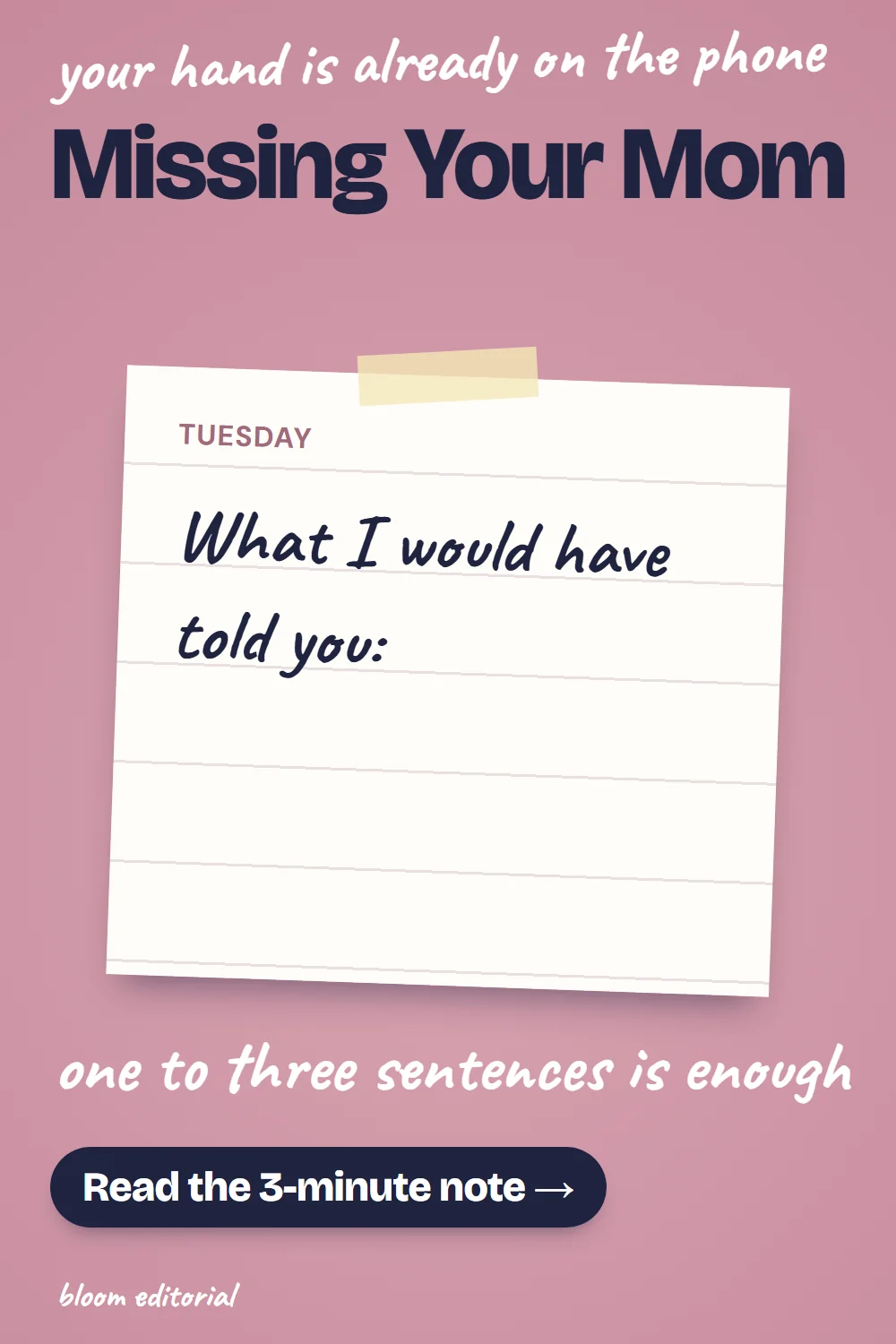


It happens on a Tuesday, in a grocery store parking lot. Something small goes right, or something small goes wrong, and your hand is already moving toward the phone. Your thumb knows where her name is.
You know what you were going to say. You can almost hear how she would answer: the way she said your name when she picked up, the short pause before she asked how you were really doing.
Then you remember.
Missing your mom does not always look like crying at a graveside. Often it looks like this: a woman standing next to her car with a phone in her hand and nobody to call with it.
Why missing your mom shows up in ordinary moments
People expect the hard days. Her birthday. Mother's Day. The date itself. On those days someone may check on you. Nobody checks on you on a Tuesday in a parking lot.
But the ordinary days are where she lived. The recipe you cannot quite remember. A sweater on a stranger that looks like one she wore. News you want to tell someone, and the only someone you want is her.
The phone is its own kind of ambush, because calling her was something your hands did before you thought about it. For years, maybe decades, she was the person you called. Your hand still knows that.
Reaching for the phone is not a mistake. It is what love does out of habit.
Reaching for the phone is not a mistake. It is what love does out of habit.
Her number may still be in your phone. Some daughters keep it. Some keep her last voicemail and cannot play it. None of this needs explaining to anyone.
The thing you were going to tell her
What stays in your hand, after you remember, is the thing you were going to say. It is usually small. What the mechanic said. That the tomatoes finally came in. That your daughter lost her first tooth. Small things are what those calls were made of.
The words have nowhere to go, and that is a large part of what hurts. So here is one place to put them: a short note called what I would have told you.
It is not a letter. It has no greeting and no goodbye. You do not have to say how you feel, or sum anything up. You write only the thing itself, the way you would have said it on the phone. It takes about three minutes, and all you need is the notes app on your phone or the back of a receipt.
It is a small thing to do in a hard moment. If it feels like too much today, leave it. The note can wait, and it can also go unwritten.
The "what I would have told you" note, step by step
- Stay where you are. Sit down if you can: the car seat, a bench, the edge of the bed. Rest the phone in your lap and take one slow breath before you do anything else.
- Open a blank note. Use the notes app or a scrap of paper. At the top, put the day of the week and the words What I would have told you.
- Write the thing itself. One to three sentences, in the words you would have used on the phone. "The car is making that noise again." "I got the job." You do not need to add that she is gone. The note already knows.
- Add her answer, only if you can hear it. One line, in her words. If you cannot hear it today, leave that line empty. An empty line is honest.
- Stop. Read the note once and close it. Three minutes is enough. It does not need to be longer, or better written, or finished.
As an example only: a daughter might write, Tuesday. What I would have told you: the hydrangea you gave me came up blue this year, not pink. I do not know why. Under it, her mother's line: It's the soil, honey. That is the whole note.
What to do with the note afterwards
You have a few choices.
- Keep them in one place. One running note in your phone with her name as the title, newest on top. Or one envelope in a drawer for the paper ones. You do not have to reread them. They only need a place.
- Say one out loud. In the car, with the windows up, read the note once in your normal phone voice. Some daughters find the sound of it harder than the writing. Some find it closer.
- Let it go. You can delete the note or throw the receipt away. It was written to give the words a place for a minute. Keeping it is optional.
One caution. If her number is no longer hers, a text sent to it may reach a stranger, and a stranger's reply is a hard thing to receive. Keep the note in your own notes, addressed to no number at all.
What you might notice
You might notice nothing. The note may feel as flat as a shopping list, and you may wonder why you bothered. That happens, and it does not mean you did it wrong or that you miss her less.
It may hurt more for a moment. Seeing the words written down, with no answer coming, can make the quiet on her end louder. If that happens, put the phone down and look at what is in front of you: the steering wheel, the trees at the edge of the lot, your own hands. Give it a minute before you drive.
You might feel her close for a second. You might feel foolish. I cannot tell you this note will help. It is only somewhere for the words to go.
If the weight is there all the time, or if you are thinking of harming yourself, a doctor, a counselor or a crisis line is the right place to turn.
When to use it
- In the moment itself, when your hand is already on the phone and you have three minutes before you have to be anywhere.
- Later that night, if the moment came in a meeting or a checkout line and you had to keep your face still and carry on.
- On days with news, good or bad, the kind she would have heard before anyone else.
This is not a daily assignment, and there is nothing to keep up. Some weeks there may be five notes. Some months there may be none. The note is for the moment when it comes, not for a schedule.
Questions women ask about missing your mom
Why does missing my mom show up on ordinary days? The ordinary days are where she lived. A recipe you cannot quite remember, a sweater on a stranger, news you want to tell someone. Nobody checks on you on a Tuesday in a parking lot.
Why do I still reach for the phone to call my mom? Calling her was something your hands did before you thought about it, for years, maybe decades. Your hand still knows that. Reaching for the phone is not a mistake.
What can I do with the things I want to tell my mom? One place to put them is a short note called what I would have told you, written the way you would have said it on the phone. It takes about three minutes. I cannot tell you it will help, and the note can also go unwritten.
The phone is one place she lived in your day. Her things are another. If you have a recipe card or a list in her handwriting, there is a small ritual for it in these ways to remember your mom through her recipes and handwriting.
You do not have to stop reaching for the phone. You do not have to train yourself out of it. There is nothing here to fix.