

It is the last week of December. The new calendar is still in its wrapper, the tree is dropping needles on the rug, and you have told yourself, again, that this will be the year you stay in the Word.
You remember how far the last reading plan got. Somewhere in February it went quiet, and by spring the bookmark hadn't moved.
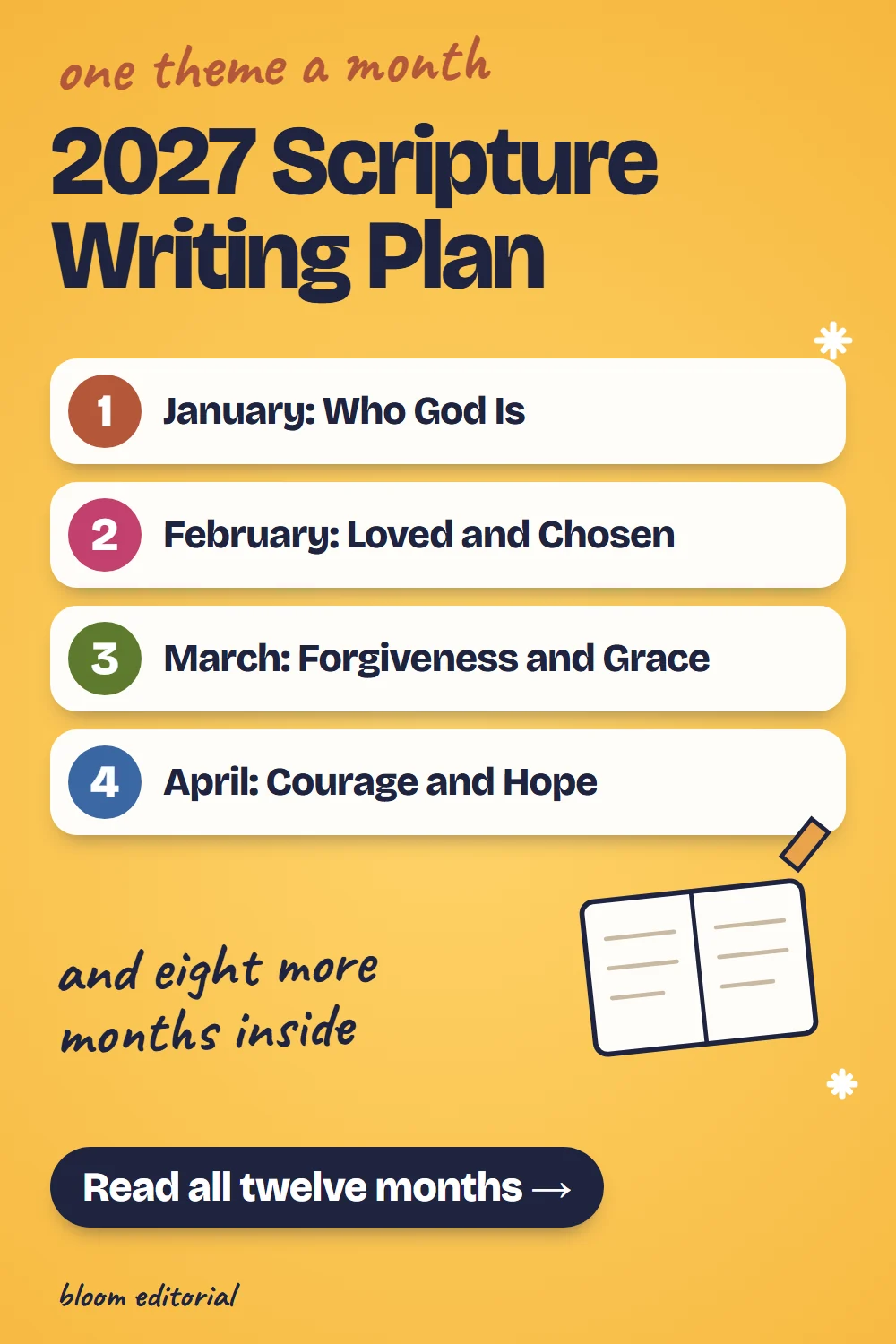
This plan for 2027 asks for less, and it gives your hands something to do. One theme a month. Eight short passages. A pen. Below are all twelve months with their references, and one way to sit down with a single passage and write it.
Why write a verse by hand
Copying is slower than reading, and the slowness is the point. Your hand has to follow every word, including the small ones your eyes have skipped for years. A verse copied by hand is a verse read at the speed of your pen.
A verse copied by hand is a verse read at the speed of your pen.
The habit is old. In Deuteronomy 17:18-19, each king of Israel is told to write out his own copy of the law and read it all the days of his life. A psalmist describes where that kind of attention leads: "Thy word have I hid in mine heart, that I might not sin against thee." (Psalm 119:11, KJV)
Every passage in this plan is from the King James Version. Its language is old, and that can help. When you have to slow down for thee and thou, you slow down enough to hear.
How scripture writing works: write, reflect, remember
The journal this plan comes from gives each passage two pages. On the first you write it out, word for word. The second is a reflection page, and those rotate between three kinds: looking closer at the words, making the passage personal, and writing it again from memory. The sitting below borrows one move from each, so you can do it tonight on any lined page.
What you need: a pen, a notebook, and the passage open in a King James Bible. How long: about fifteen minutes. If you only have five, do the first two steps and stop.
Take the last passage in January's list as an example: "The LORD is good, a strong hold in the day of trouble; and he knoweth them that trust in him." (Nahum 1:7, KJV)
- Read it out loud once. Hear the whole sentence before you write any of it.
- Copy it word for word. Go slowly. Keep the punctuation, the capitals and the old words exactly as printed.
- Underline the phrase that stopped you. One phrase only. In Nahum 1:7 it might be "a strong hold," or "he knoweth."
- Answer one question in three lines. Choose either "What does this show me about God?" or "Where do I need this right now?"
- Pray it back. Write the verse as a prayer in your own words. One or two sentences are plenty.
- Write it again from memory. Cover the passage and try. Peek if you need to. Memory grows by trying.
Scripture Journal for Women prints all 96 passages, each at the top of a lined page, so there is nothing to look up. Its reflection pages take turns among three kinds, Look Closer, Make It Personal and Hide It in My Heart, and every part ends with a Looking Back page.
The 2027 scripture writing plan, month by month
Each month takes one of the twelve parts of the journal, with that part's eight passages in the order the book prints them. The journal has no dates and its parts run in a different order. I matched them to the months of 2027, and each line says why.
- January: Who God Is. Exodus 34:6; Psalm 23:1-3; Psalm 90:2; Isaiah 40:28; Psalm 103:8; Malachi 3:6; 1 John 4:16; Nahum 1:7. A year in the Word begins with who He says He is.
- February: Loved and Chosen. Psalm 139:13-14; Jeremiah 31:3; Isaiah 43:1; Ephesians 2:10; 1 Peter 2:9; Zephaniah 3:17; John 15:16; Romans 8:38-39. A fair month to write out a love that lasts.
- March: Forgiveness and Grace. Ephesians 2:8-9; Psalm 103:12; Isaiah 1:18; Micah 7:19; Ephesians 1:7; 2 Corinthians 5:17; Psalm 32:1; Titus 3:5. Easter falls on March 28 in 2027, and these eight lead up to it.
- April: Courage and Hope. Psalm 27:1; 2 Timothy 1:7; Psalm 31:24; Jeremiah 29:11; Romans 8:28; Isaiah 43:19; Hebrews 6:19; Psalm 27:14. Spring, and a passage about a new thing.
- May: Love in Action. 1 Corinthians 13:4-5; 1 Corinthians 13:6-7; John 13:34-35; 1 John 4:19; Romans 12:10; Galatians 5:22-23; 1 Peter 4:8; 1 John 3:18. Mother's Day month, when names and faces are already on your mind.
- June: Wisdom for Everyday Life. Proverbs 2:6; Proverbs 4:23; Proverbs 16:3; Proverbs 15:1; Proverbs 31:25-26; Proverbs 16:9; Proverbs 19:21; Proverbs 9:10. All eight are from Proverbs, short enough for a porch or a suitcase.
- July: Faith and Trust. Hebrews 11:1; Psalm 37:5; Psalm 9:10; Mark 9:24; Isaiah 26:4; Psalm 20:7; 2 Corinthians 5:7; Hebrews 11:6. The middle of the year, when January's resolve has thinned.
- August: Strength for Weary Days. Isaiah 40:29; 2 Corinthians 12:9; Psalm 73:26; Philippians 4:13; Psalm 28:7; Habakkuk 3:19; Galatians 6:9; Psalm 121:1-2. For the end of summer, when the schedule starts to stack up again.
- September: Peace for an Anxious Heart. John 14:27; Isaiah 26:3; 1 Peter 5:7; Psalm 94:19; Matthew 6:34; Psalm 56:3; 2 Thessalonians 3:16; Psalm 55:22. Fall calendars fill fast.
- October: Healing and Comfort. Psalm 147:3; Jeremiah 17:14; Isaiah 53:5; Matthew 5:4; Psalm 30:5; Psalm 30:11; Psalm 119:50; Isaiah 43:2. Shorter days, and room for the tender passages before the holidays arrive.
- November: Gratitude and Praise. Psalm 100:4-5; Psalm 118:24; Psalm 107:1; Psalm 103:1-2; Psalm 9:1; Psalm 150:6; Colossians 3:17; Psalm 63:3. Thanksgiving month. Seven of the eight are psalms.
- December: Walking with Jesus. John 8:12; John 10:10; John 15:5; Matthew 5:14-16; Luke 10:41-42; John 11:25; Matthew 28:20; John 6:35. The year closes with words Jesus spoke, beginning with the light of the world.
October is the tender month. Its part includes a short written lament, and if lament is new to you, how to lament in four movements shows the shape of one. If you want to stay longer with those passages, there are more healing scriptures for the woman tired of asking. Go gently there. When a verse opens something painful, you can copy it and leave the reflection for another day.
September's eight passages on peace are also paced across four weeks, with rest days, in the December scripture writing plan, if you would rather begin before the new year.
How to pace a month
The arithmetic is simple. Eight passages a month. Two passages a week. Pick two days and keep them: Monday and Thursday, or Saturday morning and Sunday afternoon. Four weeks covers all eight.
February 2027 is exactly four weeks long. Every other month leaves two or three spare days. Use them to rewrite the passage you most want to keep, or to look back over the month and note what changed in how you see God.
Two passages in one sitting on a Sunday counts. So does one passage copied in five minutes, with the reflection left blank.
What you might notice
Sometimes a word stands up that you have read past a hundred times. Sometimes a verse you copied on Monday comes back to you on Wednesday at the sink.
And sometimes, nothing. The page is filled, the handwriting is yours, and you feel exactly as you did before you sat down. That sitting still happened. You read a passage slowly and all the way through, which is more than a hurried morning usually allows. Write the next one on its day. If a passage stirs up more than you can carry today, write only its reference, close the journal and come back to it another day.
When to use it
- Starting in January. Begin with Exodus 34:6 in the first week and write two passages a week from there.
- Starting late. Start in any month. If you find this plan in April, open April's list and begin with its first passage. The earlier months will keep.
- After a missed month. Skip it and keep going with the month you are in. Nothing to catch up, nothing to make up, and no one is keeping count.
New to this? Scripture writing for beginners walks through a first session, one verse at a time.
Questions women ask about a scripture writing plan for 2027
How long does it take to write out a passage? About fifteen minutes for one passage, with all six steps. If you only have five, do the first two steps and stop.
How many verses do I write in a week? Two passages a week, on two days you pick and keep. Four weeks covers the month's eight, and the spare days are for rewriting the passage you most want to keep.
Do I have to start a scripture writing plan in January? No. Start in any month, with the first passage on that month's list. If you miss a month, skip it and keep going with the month you are in.
The book follows the same twelve parts. Each part also has one practice page of its own, and there is a tracker with 96 squares to shade.
This plan follows the twelve parts of Scripture Journal for Women by Hannah Grace. Scripture quotations are from the King James Version.