
It's 2:47 on a Wednesday afternoon and you're in a meeting. Nothing dramatic is happening. Your chest tightens anyway, your thoughts speed up, and you're suddenly sure you're about to cry, leave, or say something you'll regret.
Most breathing exercises to calm down assume a quiet room and ten spare minutes. You have a conference table and a racing heart. The physiological sigh is a breathing exercise to calm down that fits inside the meeting itself. A round or two takes about 30 seconds, and nobody around you needs to know.
Many women in perimenopause describe this: a body that goes on alert for no obvious reason, in the afternoon meeting, at a red light, at 3 a.m. Arguing with the feeling rarely gets far. A breath gives you something physical to do while it passes.
What the physiological sigh is
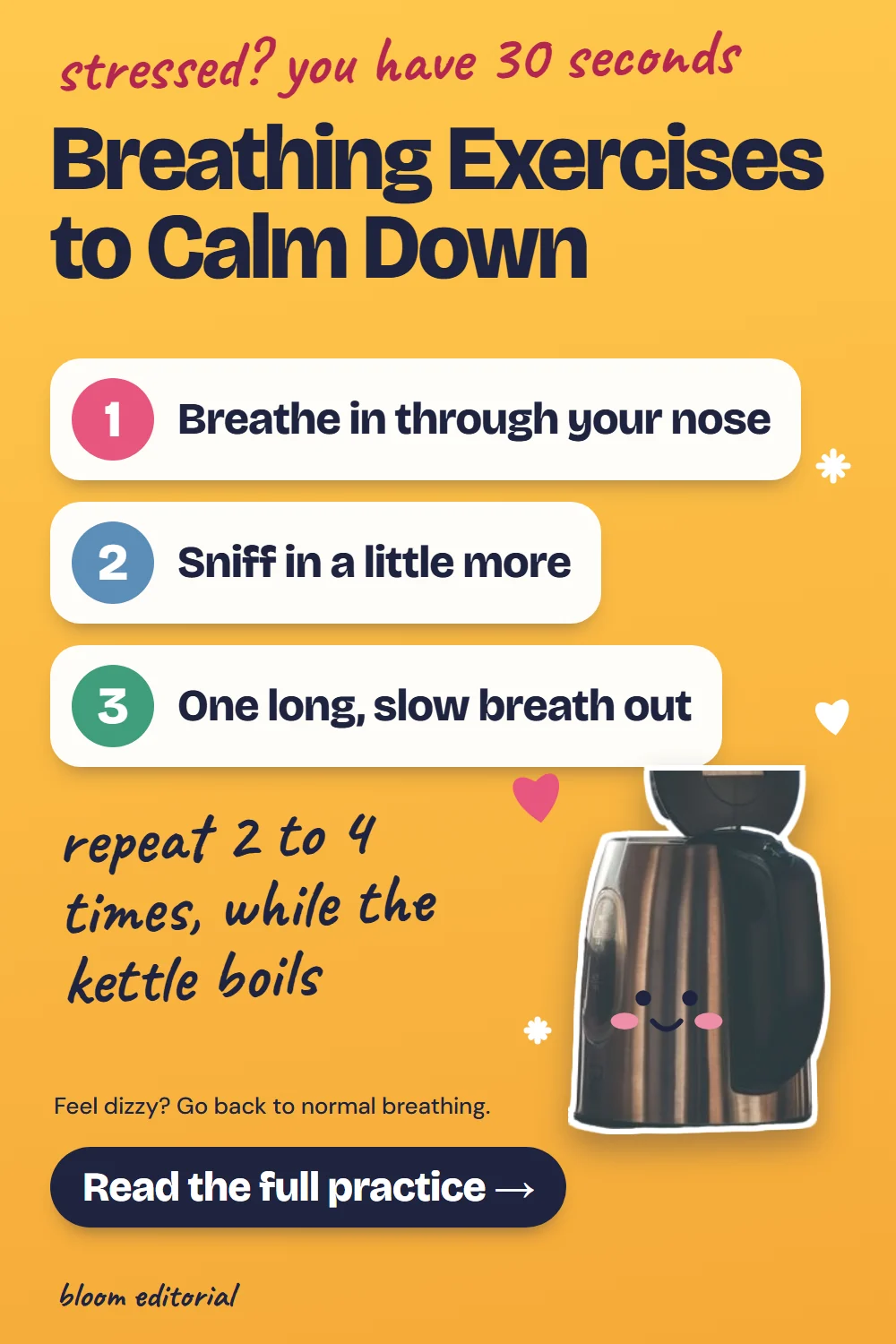
Two breaths in through your nose, the second a small sniff stacked on top of the first, then one long, slow breath out. That's all of it.
Your body already does a version of this without asking you. Sighs happen on their own every few minutes to re-inflate the tiny air sacs in your lungs (Li et al., 2016). The practice borrows that pattern and does it on purpose.
The workbook sums up the tool in one line: "The exhale is where the calm lives." The second sniff fills your lungs a little more, which leaves room for a longer breath out. Your heart rate tends to rise after you breathe in and fall after you breathe out (Lehrer & Gevirtz, 2014). Whether that fully explains why a long breath out can feel settling is still an open question, so take the line as a description of how the practice feels to many women.
Why this breathing exercise to calm down may help
The pattern was tested in a small randomized trial from Stanford (Balban et al., 2023). For a month, 108 people, most of them students in an undergraduate psychology class, spent five minutes a day on one of three breathing exercises or on mindfulness meditation. One of the breathing exercises was cyclic sighing, which is this sigh repeated.
Every group felt less anxious after a session, and on anxiety there was no clear winner between the breathing and the meditation. The sighing group had a bigger lift in positive mood than the meditators and a bigger drop in breathing rate. The authors describe the study as exploratory.
Two limits are worth saying out loud. Those people practiced for five minutes a day, and the version below is far shorter. And they were mostly students, so the trial says nothing specific about perimenopause. What follows is something to try, with no promise attached.
Before you start
Safety note: if you have asthma, COPD or any condition that affects your breathing, check with your doctor before changing your breathing pattern. If you tend to hyperventilate or get light-headed easily, go slowly and keep the breath out shorter at first. Feel dizzy? Go back to normal breathing. If paying attention to your breath makes the anxiety louder, stop, open your eyes and look around the room. Naming three things you can see is enough. You can return to normal breathing at any point.
New or worsening palpitations, chest pain or shortness of breath are a reason to talk to a doctor, however sure you are that it's hormones. This practice is meant to support professional care. It does not replace it.
How to do the physiological sigh, step by step
Sit or stand comfortably. Eyes open is fine. The counts come from the workbook and move at about one per second.
- Breathe in through your nose, a full, normal breath. (Count to 3.)
- Sniff in a little more through your nose, without breathing out first. (About one second. Your lungs will feel full.)
- Open your mouth slightly and let one long, slow breath out, until the air is gone. (Count to 6 to 8. Longer than feels natural.)
- Pause at the bottom of the breath for 1 or 2 counts.
- Repeat 2 to 4 times, then return to normal breathing.
One round adds up to 11 to 14 counts. At a count a second, two rounds take about 30 seconds and four take about a minute. The workbook allows one to two minutes for the whole practice, which leaves room to settle in first and to take a few ordinary breaths afterward.
The counts are a guide. Maya Chen teaches this same sigh with a 4-count breath in and up to three rounds, next to a slower practice, in two breathing exercises to calm down when you're stressed. If 4 suits you better than 3, use 4. The part to keep is a breath out that lasts longer than the breath in.
If the double inhale feels uncomfortable, try a single deep breath in for 4 counts and a long breath out for 8. If you need to be silent, breathe out through your nose. People in the Stanford trial were allowed to do the whole sigh through the nose (Balban et al., 2023).
On this page the sigh stands alone. In the Perimenopause Anxiety Workbook it is the first of four tools in Chapter 3: humming and cold water, a practice for looping thoughts and muscle relaxation follow it, with a page where you assign each tool to the moments that set you off.
What you might notice
- A big yawn or an involuntary sigh. Common, and worth letting through unless you're mid-presentation.
- Warmth in your chest or shoulders. Some women feel this as they slow down.
- Feeling light-headed for a breath. It can happen after the first round and usually passes quickly. If it doesn't, stop and breathe normally.
- Nothing. Also normal. Regulation is often quiet at first.
A quiet first try doesn't mean you did it wrong. In the Stanford trial, the lift in mood grew with the number of days people practiced (Balban et al., 2023), so one flat round on a hard Tuesday tells you very little.
Regulation is often quiet at first.
And if the sigh leaves you more wound up than before, drop it for today. Some days breath is the wrong door. Look around the room, feel your feet on the floor, and try again another time or leave it alone.
When to use it: the meeting, the car, 3 a.m.
In a meeting. Keep your eyes on the screen and breathe out through your nose so it stays silent. Two rounds fit comfortably inside someone else's status update.
In the car. Before you turn the key, or stopped at a red light, with your eyes open. If you're driving and feel at all light-headed, breathe normally and pull over when you safely can.
At 3 a.m. It works lying down, in the dark, without waking anyone. Do 2 to 4 rounds, then let your breathing go back to normal. It may not send you back to sleep, but it gives you something to do other than negotiate with the ceiling. If that wake-up is a regular visitor, why 3 a.m. anxiety isn't in your head looks at what may be going on.
And if the meeting is also where a word you use every week goes missing, that has its own post: perimenopause brain fog, what it is and what it is not.
It also helps to practice once when nothing is wrong. Pick one predictable moment this week, like the mid-afternoon slump. Before you reach for your phone or another coffee, do two rounds, about 30 seconds. Then notice what your body does. No transformation required.
Questions women ask about the physiological sigh
How do you do the physiological sigh? Breathe in through your nose, add a small sniff on top without breathing out, then let one long, slow breath out. The workbook counts 3 for the breath in, about one second for the sniff and 6 to 8 for the breath out. Repeat 2 to 4 times, then return to normal breathing.
How long does the physiological sigh take? At a count a second, two rounds take about 30 seconds and four take about a minute. A quiet first try doesn't mean you did it wrong: in the Stanford trial, the lift in mood grew with the number of days people practiced (Balban et al., 2023).
Does the physiological sigh help with anxiety? It may. In a small trial its authors describe as exploratory, every group felt less anxious after a session, with no clear winner on anxiety between the breathing exercises and the meditation (Balban et al., 2023). The people in it were mostly students practicing five minutes a day, so it says nothing specific about perimenopause.
The sigh is Tool 1 in Chapter 3 of the Perimenopause Anxiety Workbook, where it sits beside three other short tools and a planner for matching each one to the moments that set you off.