It's 11:47 in the morning and you're about to walk into a meeting you've been dreading. Your jaw is clenched, your shoulders are somewhere near your ears, and your heart has already decided this is an emergency. You don't have ten minutes for a breathing session. You have ninety seconds in a bathroom stall.
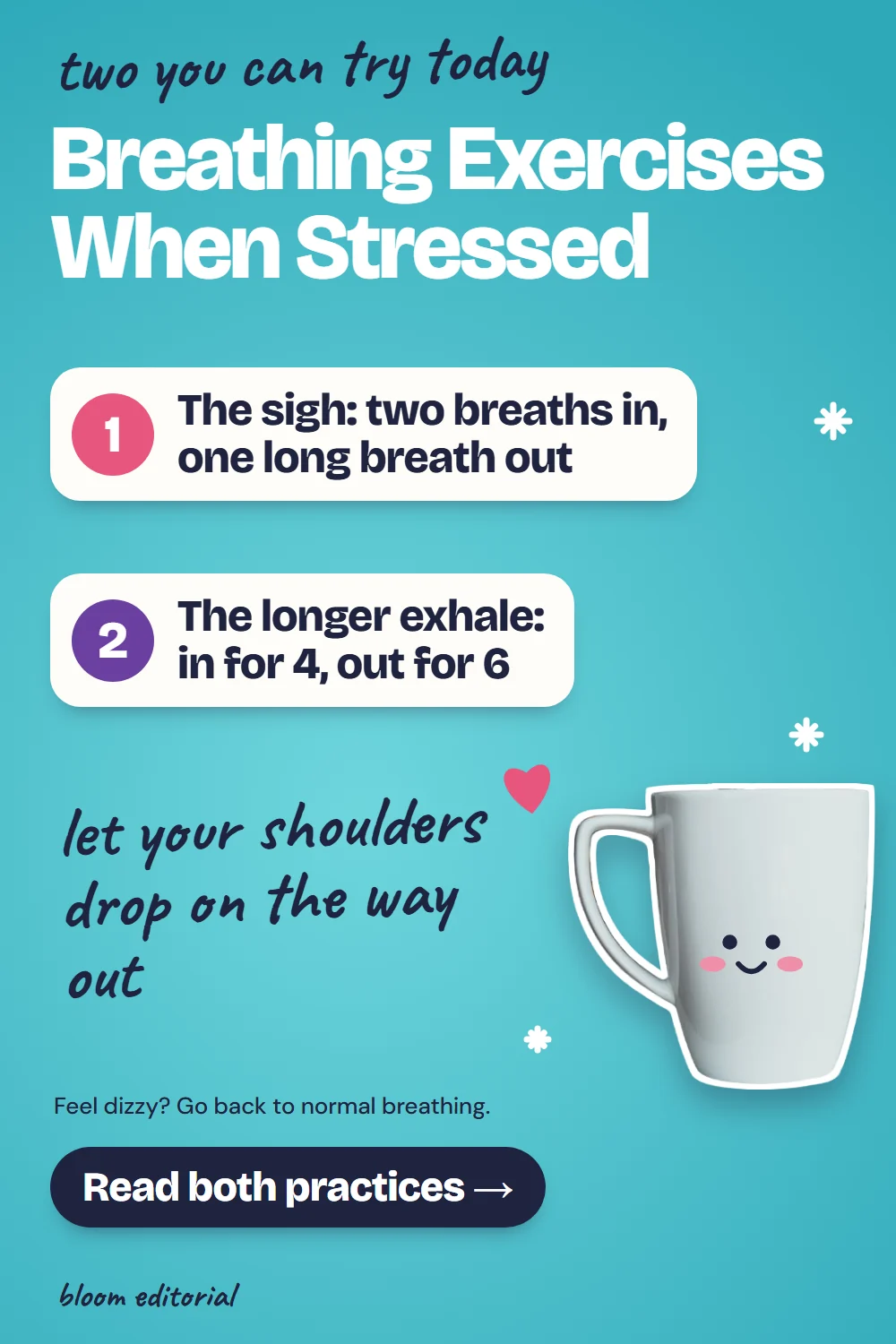
Someone has probably told you to take a deep breath. It's kind advice and it doesn't tell you much. How long? In through what? These two breathing exercises to calm down come with the actual steps: one for when you have under a minute, one for when you have three.
Being stressed in your body doesn't mean you're handling your life badly.
What a breathing exercise can and can't do
Slow, deliberate breathing can help some people feel less stressed. In a 2023 meta-analysis of 12 randomized trials, Fincham and colleagues linked breathwork with lower self-reported stress than control conditions, and the effect held in the ten trials of slow-paced breathing. The effect was small to medium, and the authors asked readers to interpret it cautiously.
The results weren't significant for groups living with mental or physical health conditions, though their numbers were close to the others, and the authors say that may reflect how few people were studied.
Think of these two practices as circuit breakers, not renovations.
Circuit breakers, not renovations.
Why your breath is worth working with
Your heart speeds up slightly as you inhale and slows slightly as you exhale. The name for that rhythm is respiratory sinus arrhythmia, and your vagus nerve is part of it (Lehrer & Gevirtz, 2014).
A longer exhale is often sold as the whole secret. The research is less tidy. In a small 2014 experiment with 30 people, Van Diest and colleagues found that breathing out for more than twice as long as breathing in led people to report more relaxation than the reverse pattern. In 2024, Meehan and Shaffer measured heart rate variability at six breaths a minute and found a 1:2 ratio did no better than even breaths, and the earlier studies they reviewed disagreed with each other. They measured different things, so nobody has the last word.
Take the long exhale as an invitation and not a formula. If it steadies you, keep it. If even breaths feel better, that counts.
Before you begin
A safety note: if you have asthma or COPD, check with your physician before practicing extended exhale breathing. If you're prone to lightheadedness or hyperventilation, go slowly and shorten the exhale at first. If you feel dizzy, return to normal breathing right away. And if you carry trauma or tend to dissociate, breathwork can occasionally feel activating rather than settling. You can stop and breathe naturally at any point.
Practice one: the physiological sigh
This is the one for the bathroom stall. It's a double inhale through the nose followed by a long, slow exhale. Sighing isn't foreign to your body, either: sighs happen on their own every few minutes to re-inflate the tiny air sacs in your lungs (Li et al., 2016).
Here's what the study actually did. In a 2023 randomized trial from Stanford (Balban et al., Cell Reports Medicine), 108 people, mostly undergraduates, spent five minutes a day for a month on one of four practices: cyclic sighing, box breathing, cyclic hyperventilation or mindfulness meditation. All four groups felt less anxious after their daily session. Cyclic sighing brought a bigger lift in positive mood than mindfulness, and a bigger drop in breathing rate. On anxiety, breathwork and mindfulness came out about even, and heart rate variability didn't differ between the groups. The authors describe the study as exploratory, and it was too small to rank the breathing styles against each other.
The version below is much shorter than what they tested, so think of it as a quick taste of the practice.
Find a seated or standing position. This takes 30 to 60 seconds.
- Inhale fully through your nose for 4 counts.
- Without exhaling, take a second, shorter sniff on top of the first, as if you're topping off a nearly full glass.
- Exhale slowly and completely through your mouth, lips slightly parted, for 6 to 8 counts. Let your shoulders drop on the way out.
- Pause naturally at the bottom of the exhale for 1 to 2 seconds.
- Return to normal breathing and notice the quality of your next few breaths.
You can repeat up to 3 cycles. If the double inhale feels uncomfortable, try a single full inhale followed by the long exhale. If you need to be quiet, exhale through your nose; people in the Stanford trial could breathe entirely through the nose.
Practice two: the longer exhale
This is the one for when you have a few minutes.
Find a comfortable seated position. This takes 1 to 3 minutes.
- Place one hand on your belly and let it rest there, without pressing.
- Inhale through your nose for 4 counts. Feel your belly rise before your chest.
- Without pausing, exhale slowly through slightly parted lips for 6 counts.
- If that feels comfortable after a few cycles, extend the exhale to 8 counts. Leave the inhale at 4.
- Continue for 6 to 10 breath cycles and let the rhythm become automatic.
- Return to your natural breath and notice how things feel now.
If counting feels like too much when you're stressed, whisper a long "shhhh" on the exhale instead.
These are Exercises 1 and 3 of the 27 in my book, Vagus Nerve Exercises for Anxiety. For the times you can't step out at all, it has three discreet tools you can use in the meeting itself, and for a spike, a 90-second sequence in three steps: orient, regulate, reanchor.
What you might notice
Your shoulders or jaw may feel heavier. You might yawn or sigh without meaning to, or feel a little drowsy. Feeling nothing is also normal, and a quiet first try doesn't tell you much: in the Stanford trial, the lift in mood from sighing grew the more days people kept at it. If the count feels forced, drop to 4 in and 5 out and build from there.
If your breath slows and the rest of you stays braced, read why can't I relax when I know I'm safe, which adds a humming practice that needs no counting.
This week, when a difficult call ends and you're still holding the phone, bring your attention to your shoulders. Try one physiological sigh before you do anything else. Then notice what your nervous system does.
Questions women ask about breathing exercises to calm down
How long do breathing exercises take to calm you down? The physiological sigh takes 30 to 60 seconds and the longer exhale takes 1 to 3 minutes. What you feel afterward varies, and feeling nothing on a first try is normal. In the Stanford trial, the lift in mood from sighing grew the more days people kept at it.
Do breathing exercises really help with stress? They can help some people feel less stressed. A 2023 meta-analysis of 12 randomized trials linked breathwork with lower self-reported stress than control conditions, with a small to medium effect that the authors asked readers to interpret cautiously. Think of these two as circuit breakers, not renovations.
Are breathing exercises safe for everyone? Some people need a check first. If you have asthma or COPD, talk with your physician before practicing extended exhale breathing, and if you're prone to lightheadedness or hyperventilation, go slowly and shorten the exhale. If you feel dizzy, return to normal breathing right away.
These practices are meant to support professional care, not replace it. If your symptoms are new or keep coming back, a doctor can check that a physical problem isn't behind them. If you take medication for anxiety, please talk with your doctor before changing anything.
If the evenings are your hardest time, the longer exhale at bedtime adapts this same breath for winding down. If you're not sure where to begin, start with nervous system regulation for beginners. And if you'd like to see what my book Vagus Nerve Exercises for Anxiety is like, you can peek inside at a full practice from it.