

It's 8:10 on a Tuesday and you are standing in the hallway with your coat on, patting every pocket. The keys were in your hand five minutes ago. You find them in the bathroom, next to the toothpaste, with no memory of putting them there.
If you have been searching for brain fog memory tips, here is the short answer. The tips that tend to hold up on a foggy day are not about remembering harder. They are about carrying less: moving what your memory keeps dropping onto paper, in one fixed place, tied to something you already do every day. Below are seven paper backups, and one you can set up today in about 10 minutes.
Why paper backups can help a foggy memory
I've written separately about what perimenopause brain fog is and what it is not, so this entry stays practical.
Using something physical to lower the load on your memory has a name: cognitive offloading. Risko and Gilbert describe it as using a physical action to change what a task demands of you and reduce the mental load, like setting your phone to remind you of an appointment (Risko & Gilbert, 2016). Writing something down is offloading. So is keeping your keys in the same spot every day.
None of this makes you less capable. Picture Joanne, 49, in the first week of a new job. She is a composite, like the other women here. By Tuesday she had lost her glasses four times before lunch. By Friday she had stopped blaming herself and picked one spot for them: the left corner of her desk, next to the monitor. Within a week she was hardly searching at all. Not because her brain had changed. She had stopped asking it to remember something it was no longer reliably doing.
Brain fog memory tips: seven paper backups
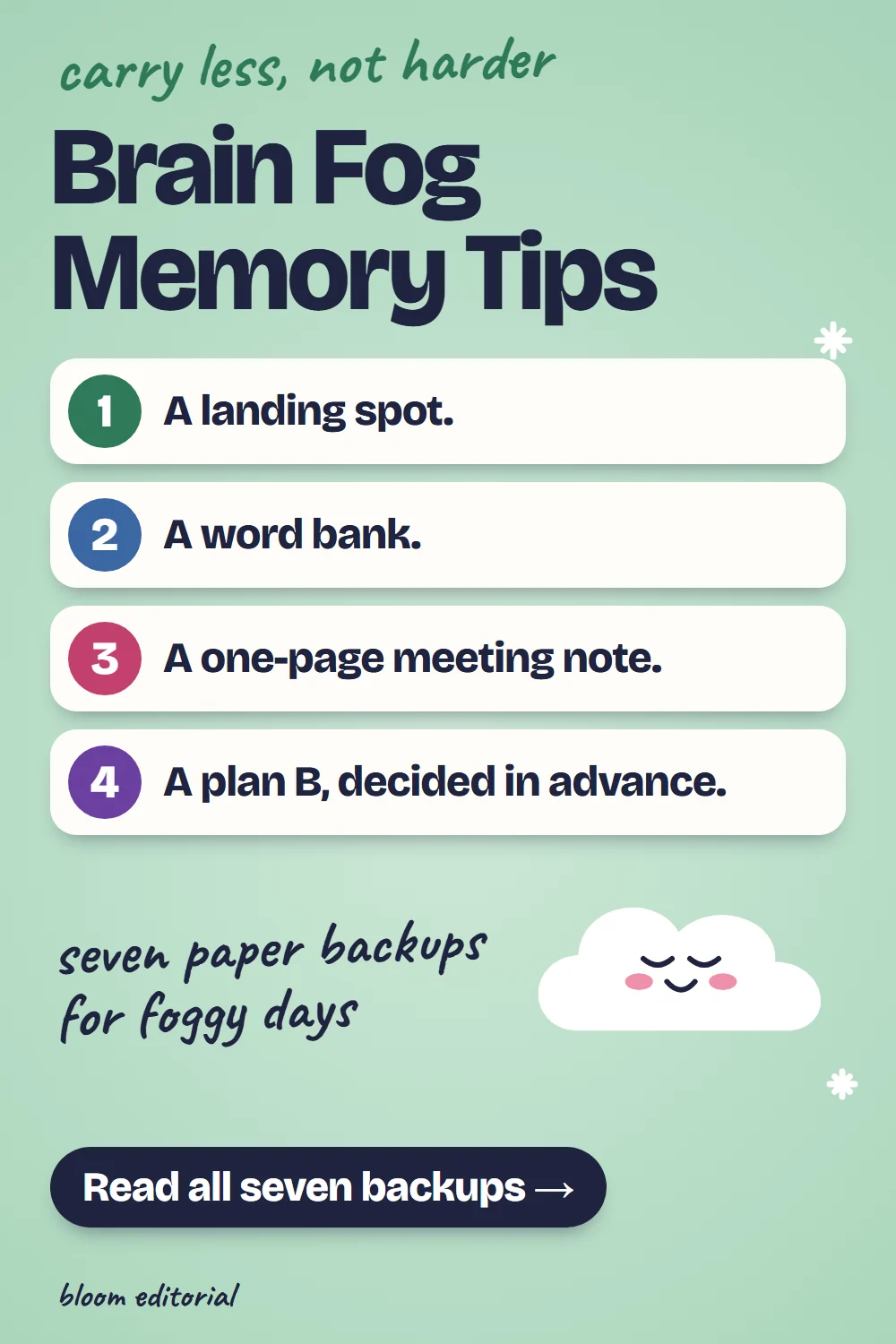
One rule runs through all seven. Each backup lives on paper, in one fixed place, and is attached to something you already do. If a system needs a good brain day to keep going, it won't survive a bad one.
- A landing spot. One fixed place for the thing you lose most: keys, glasses, badge or phone. Not a drawer, and not "somewhere on the counter." One visible spot your hands learn to go to without your brain deciding.
- A word bank. A small running list, on an index card or the inside cover of a notebook, of the words that disappear on you most: colleagues' names, work terms, phrases you need in meetings. Add one detail to place each person ("Marcus, IT, sits near the window"). Read it two minutes before a meeting. Not during.
- A one-page meeting note. Four parts, for any conversation that matters, whether it's a meeting, a hard phone call or a medical appointment: what I need to cover, what I heard, what I'm doing next (one step, with a day), and what I still want to ask.
- The "before" line. Of those four parts, the first matters most. Write the two or three things you must not leave without before the conversation starts. Once they are on paper, you can listen instead of trying to remember.
- An anchor. BJ Fogg's recipe for tiny habits is "After I [something I already do], I will [new tiny behavior]," where the anchor is a moment that already happens reliably every day (Fogg, 2020).
- A plan B, decided in advance. An "if... then I will..." plan is decided while you're calm, so you don't decide again in a foggy moment. Research on these plans, called implementation intentions, links them to following through on goals (Gollwitzer & Sheeran, 2006), and later work suggests the effect is more modest than first thought.
- An end-of-week check. On Sunday, mark the days you used each backup, then decide: keep it, tweak it or drop it. Dropping one is allowed.
You don't need all seven. Start with the one that fixes what you lose most.
A practice for today: your first landing spot
You need a pen, a sticky note and a calm moment. It takes about 10 minutes.
A note before you start: if this begins to feel like a list of everything you can no longer do, stop. One plan is enough to begin.
- Pick the one thing you lose most often. Just one to start: keys, glasses, phone or badge.
- Pick a visible surface you pass every day. Close to the door you use most, and not inside a bag.
- Mark it if that helps. A small tray, a hook or one corner of a shelf.
- Write your anchor. "After I ____, I will put ____ in ____." For example: after I close the front door, I will put my keys on the hook. The moment the door closes, not "in a minute."
- Write your plan B. "If I can't do that, then I will ____." For example: if my hands are full, my keys go in my left coat pocket, always the left, and move to the hook as soon as the bags are down.
- Put it where the moment happens. Copy the anchor and the plan B onto a sticky note and stick it beside the spot.
- Check at the end of the week. Mark the days you used it, then keep, tweak or drop it. Add a second thing only when the first one runs without thinking.
After a few weeks of the same motion at the door, your hands may know what to do before your brain does. That's the aim: a system that runs on a foggy day without a decision. The goal is not to try harder. It is to carry less.
The goal is not to try harder. It is to carry less.
These backups come from Chapter 4, "Your Outside Brain," of The Perimenopause Brain Fog Workbook. There each one gets an If... Then I Will... plan, and the paperback prints a word bank, a landing-spots table, meeting-note pages and an end-of-week check. When the hardest part is what a lost word seems to mean, Chapter 3 has A Jar for the Fear and a Check the Facts page.
What you might notice
- Awkwardness. That is what a habit tends to feel like before it is automatic.
- "I never needed this before." Your brain did this work out of sight. Right now it may be carrying more.
- A little less dread. Picture Anita, a nurse who uses a meeting note for shift handoffs. After two weeks she felt less anxious going into them. Not because she remembered more. Because she trusted the important things were written down.
- Nothing much, for a while. That's common too. A slow start doesn't mean you did it wrong.
If setting it up leaves you feeling worse, put the rest away and keep only the plan B.
When to use it
- In a week full of new information: a new job, a move, a heavy deadline.
- Before the calls where a lost word costs you most. Add the word bank: before your first call, take 20 seconds to read the card and write one thing you need to cover.
- On a foggy day, when the plan B is the plan.
How to cope with brain fog when the system slips
Every system fails some days. The word card is in your other coat. You skip the meeting note for two weeks during a deadline. Missing time resets nothing. Pick it up again the next Monday. The system is still there.
No list of perimenopause brain fog tips can tell you what is behind your fog. If you want to see when it shows up and what travels with it, I've written about how to map when menopause brain fog shows up with a 14-day notebook log. The backups carry the load; the map shows the pattern.
One calm note on when not to wait. Contact your doctor promptly, or seek urgent care, if a change in your memory or thinking is sudden or getting worse quickly. Talk to your doctor soon if everyday tasks have become hard to manage. Needing reminders for things you used to hold easily is worth mentioning too. These backups are meant to support professional care, and they do not replace it.
Questions women ask about brain fog memory tips
What are the most useful brain fog memory tips for work? At work, three tend to do the most: a word bank you read two minutes before a meeting, a one-page meeting note with what you need to cover written before it starts, and one fixed spot for your badge or glasses.
Is it cheating to write everything down? No. Using paper or a reminder to lower the load on your memory is a recognized strategy called cognitive offloading (Risko & Gilbert, 2016). Once the important things are on paper, you can listen instead of trying to hold everything at once.
What if I forget to use the system? Plan for that in advance. Write an "if... then I will..." plan B for each backup and put it on a sticky note where the moment happens. Missing a day resets nothing, so pick it up again at the next anchor.
The backups, with pages to fill in, are in The Perimenopause Brain Fog Workbook. For today, a sticky note and one spot by the door are enough to begin.