

It's 6:52 in the morning. The kettle is starting to tick, your phone is already face up on the counter, and your chest has been tight since before you opened your eyes. Nothing has happened yet today.
If you've been looking for vagus nerve exercises daily, something small enough to survive a real morning, this is the routine from my book: 10 minutes a day, in two halves. Six minutes in the morning, stacked on your coffee, and four at night, stacked on your toothbrush. Here is the morning half in full, and how to keep both going.
Why do vagus nerve exercises daily, and not once a week?
The vagus nerve is a long nerve that links your brain with your heart, lungs and gut. Your heart speeds up slightly as you breathe in and slows slightly as you breathe out, and your vagus nerve is part of that rhythm (Lehrer & Gevirtz, 2014). A slow breath gives that rhythm more room, which is why slow breathing sits at the center of this routine.
The case for every day is mostly about habit. In a study of 96 people repeating a new behavior after the same daily cue, it took about 66 days on average to feel automatic (Lally et al., 2010). Picture Teresa, 39, a composite, not a real person: two meditation apps she never opens, and coffee every single morning. That's where this routine lives.
What the morning half is made of
In healthy adults, cortisol in saliva rises by 50 to 160 percent in the first 30 minutes after waking (Clow et al., 2004), a normal part of waking up. The morning half has three parts. It opens with three physiological sighs, the double inhale from two breathing exercises to calm down when you're stressed. Then comes resonance breathing: about six breaths a minute, in for 5 and out for 5. It ends with a cold splash at the sink.
Each person's best slow pace differs a little (Vaschillo et al., 2006), so six a minute is a starting point, not your personal number. Slow breathing near that pace is the core of heart rate variability biofeedback, and a 2020 review of 58 controlled studies found a small to moderate benefit, with larger effects for anxiety, though from few studies (Lehrer et al., 2020). That was biofeedback, not four minutes with a mug, so it is no promise. The cold splash has the least behind it: I have no study of a few splashes at the sink to offer, so it is optional.
Before you begin
A safety note: if you have asthma or COPD, check with your physician before practicing paced or extended breathing. If you're prone to lightheadedness or hyperventilation, go slowly and keep the counts shorter at first. If you feel dizzy, return to normal breathing right away. And if you carry trauma or tend to dissociate, breathwork can occasionally feel activating rather than settling. You can stop and breathe naturally at any point.
If focusing on your breath raises your anxiety, do just the sighs and the splash for the first week. For the cold water: if you have a heart condition, cold water on the face can slow your heart rate sharply, so check with your physician first. If you're unsure, skip putting your face in the water and splash cool, not cold, water on your face and wrists.
The 6-minute morning sequence, step by step
Stand or sit near your kitchen sink, coffee on its way.
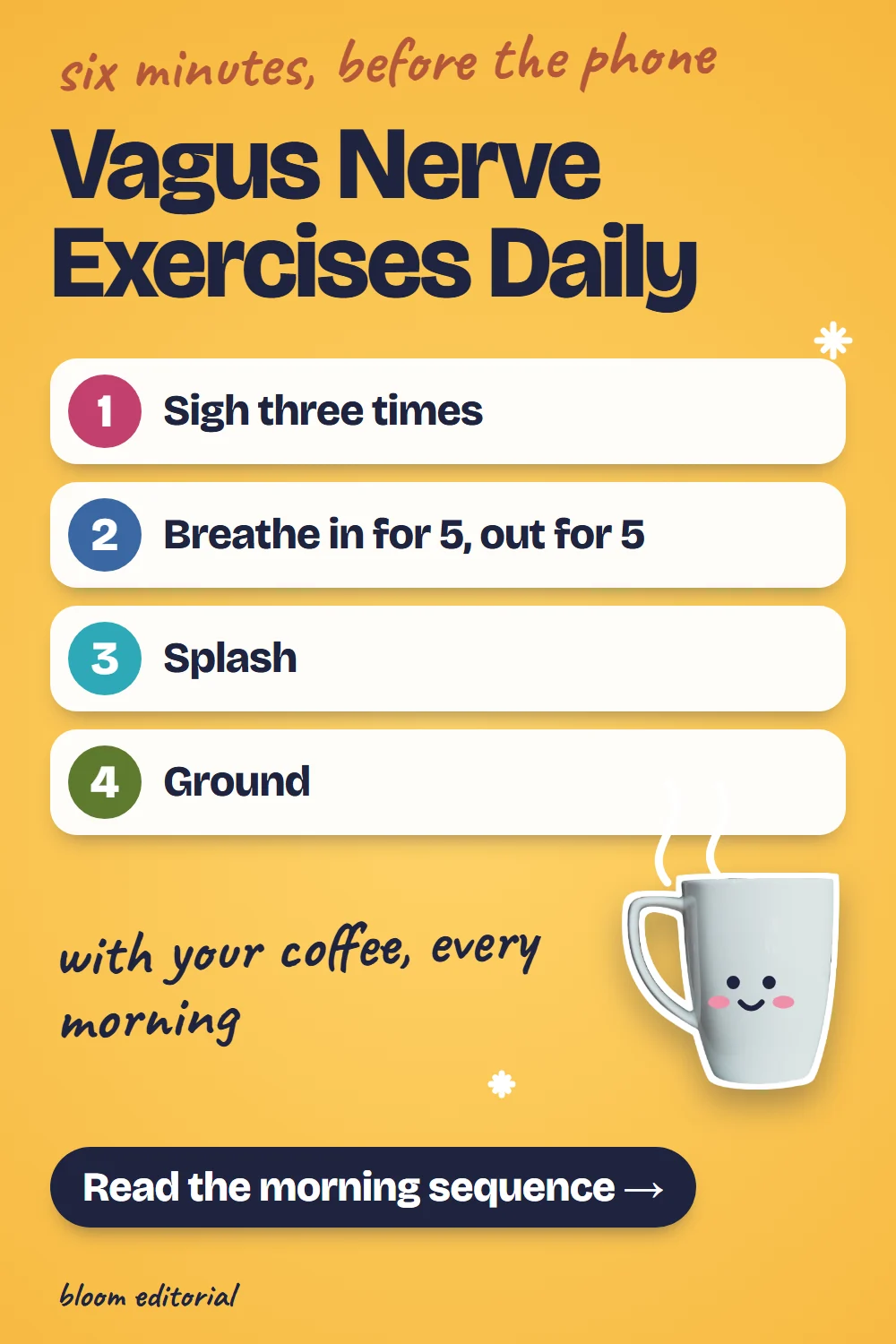
- Sigh three times. Inhale fully through your nose for 4 counts, then take a second, shorter sniff on top. Exhale slowly through your mouth for 6 to 8 counts and let your shoulders drop. Do this 3 times, about 30 seconds in all, while the kettle boils.
- Pick up your mug. Hold it in both hands and feel the heat. This is your cue for the next step.
- Breathe in for 5, out for 5. Inhale through your nose for 5 counts and exhale through your nose or mouth for 5 counts. Continue for 4 minutes, about 24 breaths, feeling your belly rise and fall.
- Set the mug down and move to the sink.
- Splash. Splash cold tap water over your forehead, cheeks and the back of your neck 3 to 5 times, or put your face in a sink of water for 15 to 30 seconds if that's comfortable. Breathe out as you lift your face. About 30 seconds.
- Ground. Stand upright and take one slow breath. Notice how your body feels now. You don't need to feel different.
The timed steps add up to 5 minutes: 30 seconds of sighs, 4 minutes of slow breathing and about 30 seconds at the sink. The hand-offs and closing breath fill the sixth.
If sitting is uncomfortable, do the slow breathing standing at the counter or lying in bed before you get up. If the cold is too much, use cool water for the first two weeks; moving to colder water is one of the book's upgrades for week 3.
This is Exercise 4A in my book, Vagus Nerve Exercises for Anxiety. The book adds the structure for keeping it: a page for deciding where each step goes in your morning, a 28-day log where you rate your anxiety from 0 to 5 each morning before you start, and one small upgrade at a time in weeks 3 and 4, such as 2 minutes of humming after the splash.
How the two halves make one daily vagus nerve routine
The evening half is the 4-minute wind-down at your toothbrush: 2 minutes of breathing in for 4 and out for 8 (6 if 8 feels strained) before you brush, then 2 minutes of humming while you change and dim the lights. The full steps and their safety note are in breathing exercises for sleep: the longer exhale at bedtime.
Together they make the 10 minutes. In the book, the first two weeks have one job: do both halves every day, at the same length, without stretching the breathing or pushing the water colder. Some evenings you'll forget and do the wind-down in bed, half asleep. That counts. Imperfect practice still counts.
Imperfect practice still counts.
How to keep a nervous system regulation routine going
- Stack it on coffee. Sighs while the kettle boils, slow breathing with the mug in your hands, the splash before you get dressed.
- Stack it on your toothbrush. Breathing just before you brush, humming just after, until the light goes off.
- Name the moment. Before Day 1, the book asks you to finish a sentence: "Every morning, I will begin my physiological sighs at ___ in ___."
- Keep a minimum for hard days. When you're sick, traveling or short on sleep, the book's minimum is three sighs in the morning and 2 minutes of humming before sleep.
- Watch the week, not the day. If you use the book's log, write the number down and look at the trend each week.
What you might notice
You might yawn, sigh or shudder after the sighs, or feel a mild warmth in your chest after the slow breathing. If tingling in your hands or face grows, breathe normally for a minute before you go on.
You might also notice nothing, or feel slightly restless, especially in the first week. That's common and it doesn't mean you did it wrong. Feeling that nothing is happening is different from feeling worse: if the morning sequence keeps leaving you more anxious, stop, go back to the sighs alone, and mention it to your doctor.
When to use it
- Right after you wake, before the phone, while the kettle heats.
- In bed before you get up, with the slow breathing done lying down.
If you wake braced at 3 a.m. rather than at 7, try these vagus nerve exercises you can do in bed. New to all of this? Start with nervous system regulation for beginners and its 3-minute check-in.
This week, when the kettle clicks on, bring your attention to your shoulders. Take one physiological sigh before you reach for your phone. Then notice what your nervous system does.
Questions women ask about daily vagus nerve exercises
How long until I notice anything? It varies, and I can't give you a timeline. Many people notice nothing at first, which is common. The book's 0 to 5 log lets you look at weeks of numbers instead of judging one morning.
Can I do vagus nerve exercises every day? This routine is built for every day: six minutes in the morning and four at night, at the same length for the first two weeks. With a heart condition, ask your physician before the cold splash.
What if I miss a day? Start again the next morning at the usual length. On hard days, three sighs in the morning and 2 minutes of humming at night are the book's minimum. If you miss more than 3 days in a row after adding an upgrade, the book has you go back to the basic six and four first.
These practices are meant to support professional care, not replace it. If your symptoms are new or keep coming back, a doctor can check that a physical problem isn't behind them. If you take medication for anxiety, please talk with your doctor before changing anything.
The morning and evening sequences, the 28-day log and the hard-day minimum are all in Chapter 4 of my book, Vagus Nerve Exercises for Anxiety.