
It's 11:20 and the lamp has been off for half an hour. Beside you, someone is breathing the slow breath of a person who fell asleep in four minutes. You are flat on your back with your jaw set and your hands curled, running tomorrow's meeting for the third time. Getting up would wake the house.
Most vagus nerve exercises you'll find ask for a chair, a sink of cold water or a voice at full volume. The three vagus nerve exercises in bed below are done lying down, in the dark, quietly enough that the person next to you keeps sleeping.
What vagus nerve exercises in bed can and can't do
The vagus nerve is a long nerve that links your brain with your heart, lungs and gut. It is the principal relay for sensory information from your lungs, windpipe and voice box (Prescott & Liberles, 2022). So how you are breathing is part of what your brain is working with.
"Vagus nerve exercises" is a popular, loose name for practices like the ones below. I can't point you to research that tested any of them in bed or measured sleep. They come from my book as practices: small, physical things to do with a body that is still braced. They may help you settle. They come with no promise about sleep.
Picture Carmen, 41, a composite, not a real person. She knows the meeting will go fine, and her hands are fists under the blanket anyway. Start with whatever is already clenched.
Start with whatever is already clenched.
Before you begin
A safety note: the third exercise is a long exhale. If you have asthma, COPD or another breathing condition, check with your physician before practicing it. If you feel dizzy or lightheaded, return to normal breathing right away. If paying attention to your breath tends to raise your anxiety, skip the hum and stay with the first two exercises. And if you carry trauma or tend to dissociate, lying still in the dark can feel activating rather than settling. Keep your eyes open, and at any point you can stop and breathe normally.
If you have a vocal cord injury or have had recent throat surgery, check with your physician before humming. If you have pain, an injury or arthritis in your hands or wrists, skip the fist squeeze. It should be firm and never painful.
Exercise 1: the fist squeeze
Tensing a muscle on purpose and then letting it go comes from progressive relaxation, a method the physician Edmund Jacobson developed in the early twentieth century (Jacobson, 1929). The book borrows that one move for the hands, on the idea that a release is easier to feel right after a squeeze. I have no study of this short version to offer.
Stay as you are, on your back or your side. This takes about 30 seconds.
- Squeeze. Close both hands into fists at about 70 percent of your full grip.
- Hold for 7 seconds. Keep breathing while you hold.
- Release completely. Let your fingers spread and your palms go soft.
- Feel the weight of your hands on the sheet or on your belly for 10 seconds.
One squeeze is the whole exercise.
Exercise 2: jaw, shoulders, heels
This one comes from the book's sequence for waking at 3 a.m. I know of no research on it as a set. It is a way of checking, in order, the places that tend to brace. Allow about 1 minute.
- Look. Keep your eyes open and let your gaze go soft. Find two or three shapes you can see in the dark. You are in your room.
- Jaw. Let your back teeth come slightly apart and let your tongue drop away from the roof of your mouth. Keep your lips gently closed. Stay there for 10 seconds.
- Shoulders. Let them drop away from your ears and into the mattress. Stay for 10 seconds.
- Hands. Check them. If they have closed again, let them open.
- Heels. Press both heels into the mattress. Feel the weight and the pressure, then ease off.
Exercise 3: the quiet hum
A hum is a long exhale with sound in it. Your heart rate tends to rise after you breathe in and fall after you breathe out (Lehrer & Gevirtz, 2014), which is the plain logic behind practices that lean on the exhale.
The evidence for humming itself is preliminary. In a 2013 study, healthy young people hummed a single tone, sang a hymn and sang a slow mantra, and singing in regular phrases brought their heart rate into step with their breathing (Vickhoff et al., 2013). That study was about singing and it didn't look at sleep, so hold it loosely.
The bed version is the book's quiet variation: a long "mmm" with your lips barely parted. It takes 1 to 2 minutes.
- Breathe in normally through your nose.
- Hum out. As you exhale, make a quiet "mmm" on any single tone, for the whole length of the breath.
- Feel it. Rest one hand on your breastbone and notice the vibration in your lips, your throat and your chest.
- Repeat for 6 to 10 breaths, about 1 to 2 minutes.
- Listen. After your last hum, lie in silence for 10 to 15 seconds.
The seated, full-voice version is in why you can't relax when your body doesn't feel safe.
The in-bed sequence, start to finish
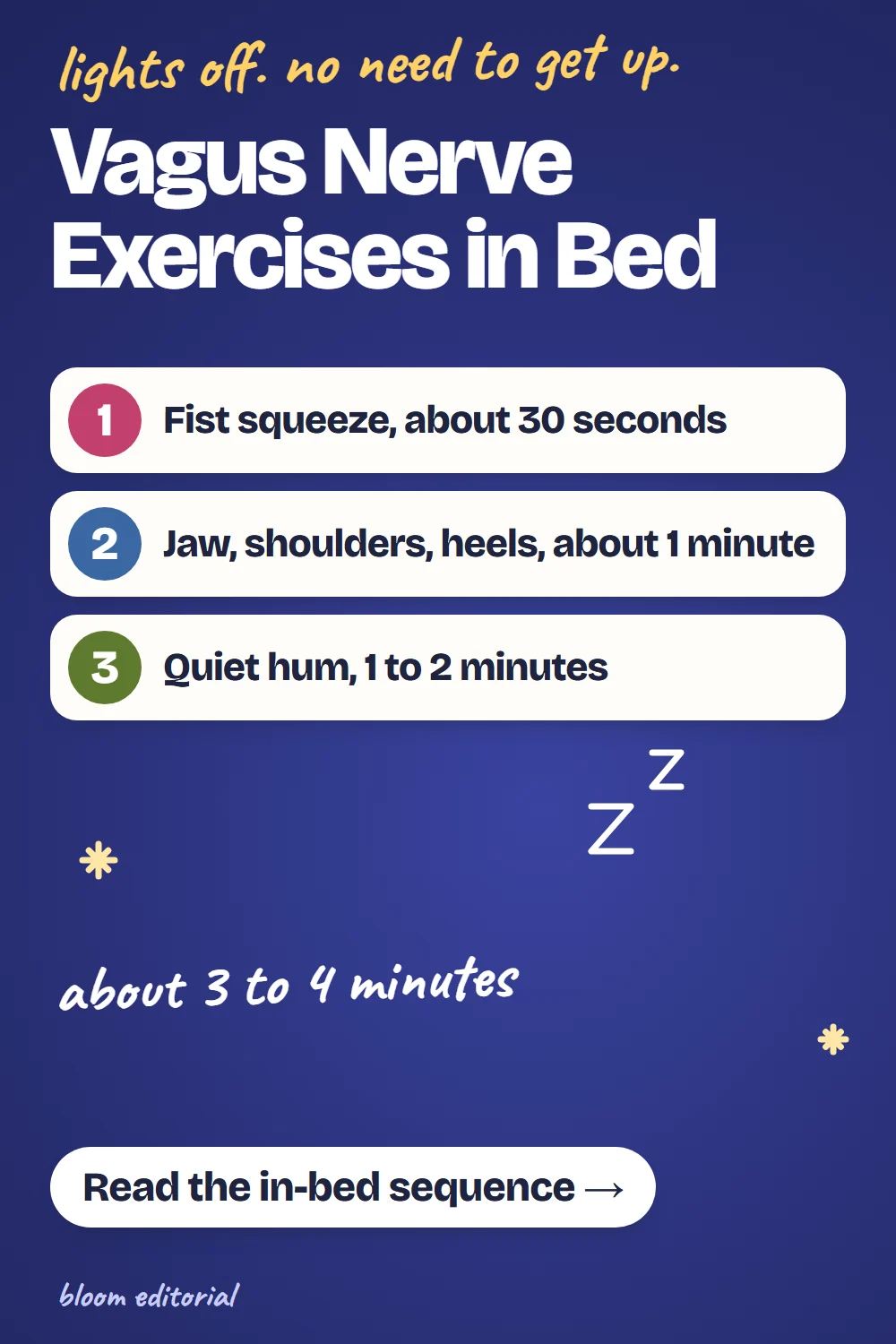
- Fist squeeze, about 30 seconds: 70 percent grip, 7 seconds, release.
- Jaw, shoulders, heels, about 1 minute: 10 seconds for the jaw, 10 for the shoulders, hands open, heels pressed.
- Quiet hum, 1 to 2 minutes: 6 to 10 hummed exhales, then 10 to 15 seconds of silence.
That adds up to about 3 minutes with six hums and closer to 4 with ten.
The fist squeeze and the jaw release come from the chapter on anxiety spikes in my book, Vagus Nerve Exercises for Anxiety. There, the squeeze is one of three discreet tools for moments when you can't step away, such as a meeting, alongside a 90-second sequence for a spike.
The book's own 3 a.m. sequence has two breathing steps that I've left out, because each has its own entry. One is a double inhale with a long exhale, done twice. The steps are in two breathing exercises to calm down when you're stressed. The other is in for 4, out for 8, which the book suggests for 3 minutes if you are still wide awake afterward. It is the center of the longer exhale at bedtime. The book's rule for the night applies here too: don't check the time until you have finished.
And if the words around all of this are new to you, nervous system regulation for beginners gives you a plain map of the three states and a 3-minute check-in.
What you might notice
Your hands may feel warm or heavy after the squeeze. You might yawn or sigh, or feel the hum in your chest and the bones of your face.
You might also notice nothing. That is a common first result. Feeling more awake at first can happen too. Paying attention to your body can leave you more alert for a few minutes.
If any of it leaves you more on edge, floaty or short of air, stop. Open your eyes, breathe normally and name five things you can see.
When to use it
- Falling asleep, when the lamp is off and your mind is still at work. Start with the fists.
- At the 3 a.m. wake-up, before you reach for your phone. Begin with the shapes in the dark, then the jaw.
- On a weekend morning, before you get up, when you wake already braced.
Questions women ask about vagus nerve exercises in bed
Can you do vagus nerve exercises lying down? You can do these three lying down, in the dark, without getting up. They are quiet enough that the person next to you keeps sleeping.
How long do vagus nerve exercises in bed take? About 3 minutes with six hums and closer to 4 with ten. The fist squeeze takes about 30 seconds, the jaw, shoulders and heels about 1 minute, and the quiet hum 1 to 2 minutes.
Do vagus nerve exercises help you sleep? I can't promise that. I can't point you to research that tested any of these in bed or measured sleep, though they may help you settle. Sleep trouble that keeps coming back is worth raising with a doctor.
These practices are meant to support professional care. They don't replace it. Sleep trouble that keeps coming back is worth raising with a doctor, who can check whether something physical is behind it. If you take medication for anxiety or sleep, please talk with your doctor before changing anything.
All three exercises come from my book, Vagus Nerve Exercises for Anxiety. It has the full 3 a.m. sequence and 27 ranked exercises, each with a note on how strong its evidence is.