

It is 3 a.m. and the house is dark. The worry that sat with you all day has followed you to bed, and the prayer you try to say keeps falling apart halfway through. You know God is listening. You just can't find the words.
These prayer journal prompts are for nights like that, and for the mornings after. They come from Part Two of Daily Prayer Journal for Women, a section called When Life Is Heavy, which opens with this line: "Some seasons, prayer feels less like a conversation and more like holding on." Below are seven prompts from its pages, each with the verse it rests on, and one complete practice you can do today with a pen and any sheet of paper.
What to pray when life is hard
A prompt hands you the first half of a sentence, and you only have to finish it. The book puts it simply: "You don't have to tidy them up first. Bring them as they are."
Every week of Part Two opens with a King James verse, a short reflection, a prayer to begin and a practice drawn from that verse. Then each daily entry asks the same four things:
- "What feels heavy today"
- "What I'm placing in Your hands"
- "A promise I'm holding onto"
- "Thank You, even today, for"
Those four lines are a prompt in themselves. On a hard day, filling only the first one is still a prayer.
Seven prayer journal prompts for hard days
Each comes from a different page of Part Two. Copy the words in quotation marks and write underneath.
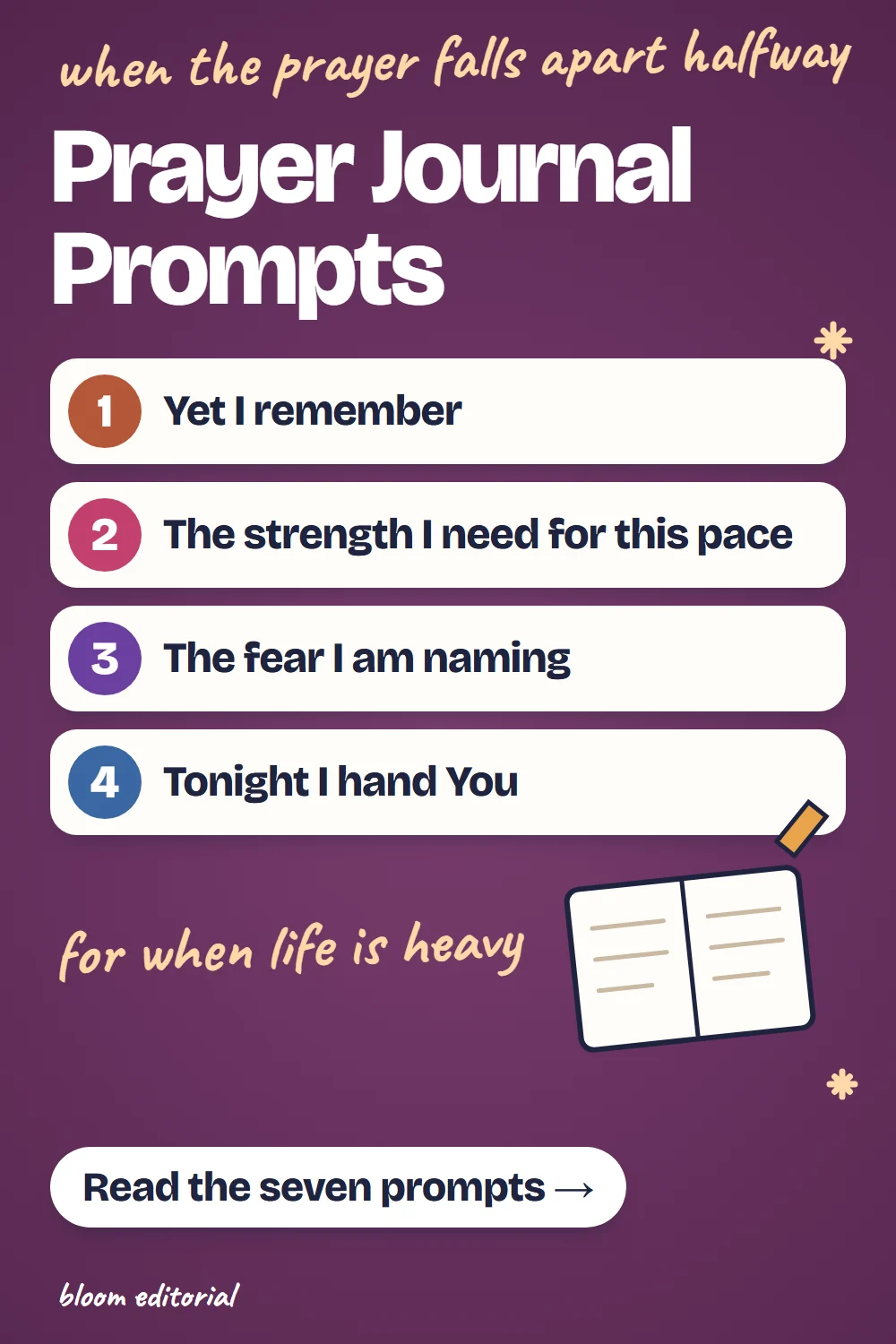
- Name the heaviest thing (Part Two opener). Before the first week begins, there is one page with one prompt: "What feels heaviest right now, and what I'm asking God to do."
- Yet I remember (Week 15, When Your Heart Is Broken). The verse is "The LORD is nigh unto them that are of a broken heart; and saveth such as be of a contrite spirit." (Psalm 34:18, KJV) The week's lament has five steps, and the middle one turns the prayer: "Yet I remember: a time He was near, or a promise." If the grief is old and has never had words, how to lament a wound you stopped naming walks through a longer written lament.
- Soar, run, or walk? (Week 16, When You Are Waiting). Isaiah names three paces: "they shall mount up with wings as eagles; they shall run, and not be weary; and they shall walk, and not faint." (Isaiah 40:31, KJV) Circle the one that is true this week and finish the line "The strength I need for this pace." The book adds: "All three count."
- The fear I am naming (Week 17, When You Are Afraid). Isaiah 41:10 holds five promises, beginning "Fear thou not; for I am with thee" (KJV). Pick the one you need most. Write "The fear I am naming," then "What this promise says to that fear."
- Talk to your soul (Week 20, When Life Disappoints You). The psalmist asks himself a question: "Why art thou cast down, O my soul? and why art thou disquieted within me? hope thou in God" (Psalm 42:11, KJV). Write the first half as a heading and let your soul answer honestly. Then write "Hope thou in God" and reply the way a kind friend would.
- Two voices (Week 23, When Shame Speaks). Draw a line down the middle of the page. On the left, under "What shame says," write its exact words. On the right, under "What God says," answer each line with "There is therefore now no condemnation to them which are in Christ Jesus" (Romans 8:1, KJV).
- Tonight I hand You (Week 25, When You Cannot Rest). Before you sleep, list what you can't fix tonight, and check each one as you hand it to God. The page closes with "I will both lay me down in peace, and sleep" (Psalm 4:8, KJV).
For the gentler starting points from the first part of the same journal, see prayer journal ideas for when you don't know what to say.
Prayer prompts for hard times are not a test
Picture a woman I'll call Dana. She is a composite, drawn from what many women describe. Every prayer she starts turns into the same worry written a new way, and she believes a good prayer should sound settled. Week 14 reads Paul's words, written from prison, and notes: "He didn't promise the problem would disappear. He promised a peace that would stand guard over your heart and mind." A heavy prayer does not have to sound settled to be a prayer.
A heavy prayer does not have to sound settled to be a prayer.
A practice for today: worry, request, thanks
This is the Week 14 practice, from When You Are Anxious, moved onto plain paper. It rests on this verse:
"Be careful for nothing; but in every thing by prayer and supplication with thanksgiving let your requests be made known unto God. And the peace of God, which passeth all understanding, shall keep your hearts and minds through Christ Jesus." (Philippians 4:6-7, KJV)
"Be careful for nothing" is the old English way of saying don't be anxious about anything. The book's instruction is short: "turn each worry into a request, then add a thank-you. One row per worry." It sets no length of time. Ten to fifteen minutes is enough.
- Read the verse slowly, once, out loud if you can.
- Draw three columns and label them "My worry," "What I ask instead" and "Thank You for."
- Write one worry in the first column, as plainly as you would say it to a friend: the test result, the bill.
- Turn it into a request in the second column. Ask for something specific, such as courage for the conversation or sleep tonight.
- Add one thank-you in the third column. It doesn't have to match the worry. Something small counts.
- Repeat, one row per worry, until the worries you came with are on the page or you are ready to stop.
- Close with the week's prayer: "Lord, You see every worry I'm carrying. I'm turning them into prayers right now. Guard my heart and mind with Your peace."
In Daily Prayer Journal for Women, this page is already drawn, and it is one of thirteen weeks in Part Two, Weeks 14 to 26, each with its own verse, reflection, prayer and practice. Six daily entries a week carry the four heavy-day lines, printed and waiting for a date, and a Day 7 page asks two questions written for that week's verse, such as "Which worry did I turn into a prayer this week? What happened in me afterward?" Before the first week, a page called When It Feels Heavy sets out how to carry the tender pages: go at your own pace, know when to stop, and close the page gently.
What you might notice
You might notice the first column fills quickly and the second one slowly. Asking can be harder than worrying. You might also notice nothing. The worry may still be there when you put the pen down. That is an honest result, and it says nothing about whether you were heard.
Tears are possible too, sometimes on the thank-you column of all places. Let them come. The journal's advice after a heavy page is to do something with your body: "Stand up, stretch, drink a glass of water, or step outside for a minute. Then say one sentence of thanks, even a small one." If the heaviness doesn't lift by the end of the day, set the page aside and talk to someone you trust. A heavy season can also deserve a pastor, a counselor or a doctor, and reaching for one is not a failure of prayer. If you are thinking about harming yourself, call or text 988 in the United States, or your local emergency number.
When to use it
- When worry wakes you at night. One row is enough.
- Before a hard appointment or phone call. In the parked car, with the engine off.
- At the end of a long week. Read back over your rows: "Prayers answered, and prayers I'm still waiting on."
Questions women ask about prayer journal prompts
What should I write in a prayer journal when life is hard? Start with one line: "What feels heavy today." Then, if you can, "What I'm placing in Your hands," "A promise I'm holding onto" and "Thank You, even today, for." Filling only the first line is still a prayer.
What if I'm too tired or sad to write much? Write as much or as little as you can, and stop whenever you need to. The journal calls every practice "an invitation, not an assignment." A single row of worry, request and thanks is a full entry.
Is it okay to write angry or doubtful prayers? The psalmist asked his own soul why it was cast down, and the book calls that "a question, not a scolding." Part Two gives whole weeks to anger, disappointment and shame. Write them honestly, then add one line that begins "Yet I remember."
The house will be dark again some night. The page beside the bed will already have a first line on it.
These prompts come from Daily Prayer Journal for Women by Hannah Grace. Scripture quotations are from the King James Version.