
Peek inside
A true sentence and a small practice, for today.
Real words and real exercises from our books. Find the season you're in and try one right now. You don't have to buy anything to begin.
Anxiety & nervous system
Your mind knows you're okay. Your body hasn't heard.
Your nervous system isn't broken. It's been protecting you with the tools it had. The work now is giving it better ones.
Vagal resilience doesn't mean you stop getting activated. It means you stop staying there.
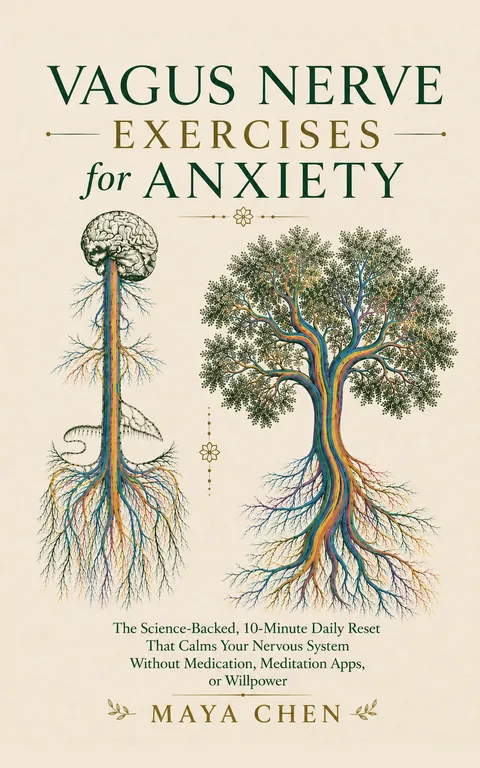
From Vagus Nerve Exercises for Anxiety, by Maya Chen
Try it now · Under a minute
The Physiological Sigh
Something your body already knows how to do. Find a seated or standing position.
A safety note. If you're prone to lightheadedness or hyperventilation, go slowly with the double inhale and reduce the exhale duration on your first attempt. If you feel dizzy, return to normal breathing immediately.
- Inhale fully through your nose. (4 counts)
- Without exhaling, take a second, shorter sniff through your nose on top of the first inhale, as if you're topping off a nearly full glass. You'll feel your chest and belly expand further.
- Now exhale slowly and completely through your mouth, lips slightly parted, for 6 to 8 counts. Let it be longer than feels necessary. Let your shoulders drop on the way out.
- Pause naturally at the bottom of the exhale, 1 to 2 seconds.
- Return to normal breathing. Notice the quality of your next few breaths.
Feeling nothing is also normal. Do 2 or 3 cycles and notice cumulatively.
There's more where this came from.
A 10-minute daily reset with step-by-step practices you can actually do.
Paperback on Amazon (opens in a new tab)Kindle on Amazon (opens in a new tab)Hardcover on Amazon (opens in a new tab)
Faith & healing
You keep praying, and you can't feel a thing.
Your wound doesn't have to be the worst wound in the room to deserve a name.
The middle is not evidence that you're failing. It's evidence that you started.
From Healing Bible Study for Women, by Hannah Grace
Try it now · A few quiet minutes and a pen
Naming the Wound for the Healer
Name what you're actually bringing. Not the general category ("my health," "my grief") but the specific, particular wound you are carrying right now.
- Write a single, specific sentence that names what you most need healing from right now.
- Not "my anxiety": "the anxiety that wakes me up at 3 a.m. convinced my marriage is ending."
- Not "my grief": "the grief over my mother's death that I haven't been able to talk about for two years because everyone expects me to be over it."
The naming is not for His information. He already knows. It's for yours. When we name the wound honestly before God, we stop carrying it in the dark.

There's more where this came from.
A 6-week, Scripture-based journey to restore your broken heart and renew your mind.
Paperback on Amazon (opens in a new tab)Kindle on Amazon (opens in a new tab)Hardcover on Amazon (opens in a new tab)
Perimenopause
It's 3 a.m. again, and you don't recognize yourself.
You are not your thoughts. You are the person noticing them. That distance is everything.
Your body is not your enemy. It is responding to a real, massive hormonal shift with the tools it has. You're simply giving it better ones.
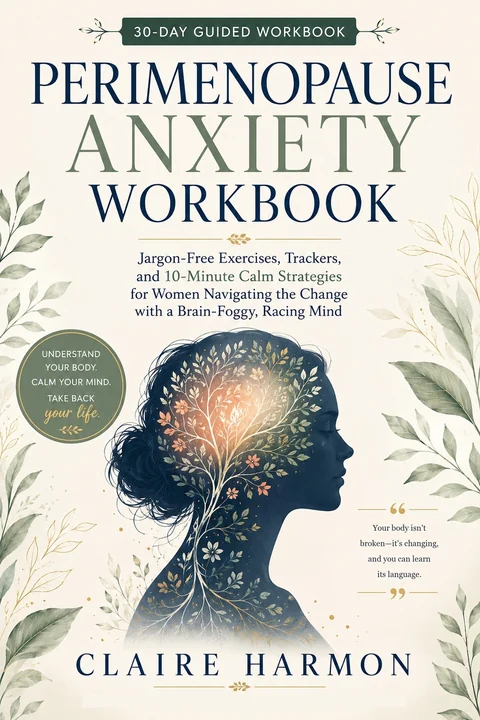
From Perimenopause Anxiety Workbook, by Claire Harmon
Try it now · 3 to 5 minutes
"I'm Having the Thought That..."
This exercise creates distance between you and an anxious thought, not by changing the thought, but by changing your relationship to it.
A safety note. If you're currently in acute distress or crisis, please reach out to a mental health professional. This technique works best for the everyday anxiety spiral, not a mental health emergency.
- Identify the anxious thought that is most active right now. Don't reach for the most logical one. Write the one that actually keeps arriving, exactly as it sounds in your head.
- Now rewrite that thought using the stem: "I'm having the thought that..."
- Read your rewritten sentence aloud or in your head. Notice how it feels different from the original. You don't need to believe it is different. Just notice if there's any shift, even a small one.
- Add one more layer if you want to go further: "I notice that I'm having the thought that..."
- Sit with the defused version for 60 seconds. Breathe normally. You don't need to do anything with the thought. Just let it be there, labeled, at arm's length.
There's more where this came from.
A 30-day guided workbook with trackers and 10-minute calm strategies.
Paperback on Amazon (opens in a new tab)Kindle on Amazon (opens in a new tab)
Grief & remembering Mom
You reach for the phone to call her, and then you remember.
Clara's journals are still being written. Until then, she wrote this for you.
Read Clara's note