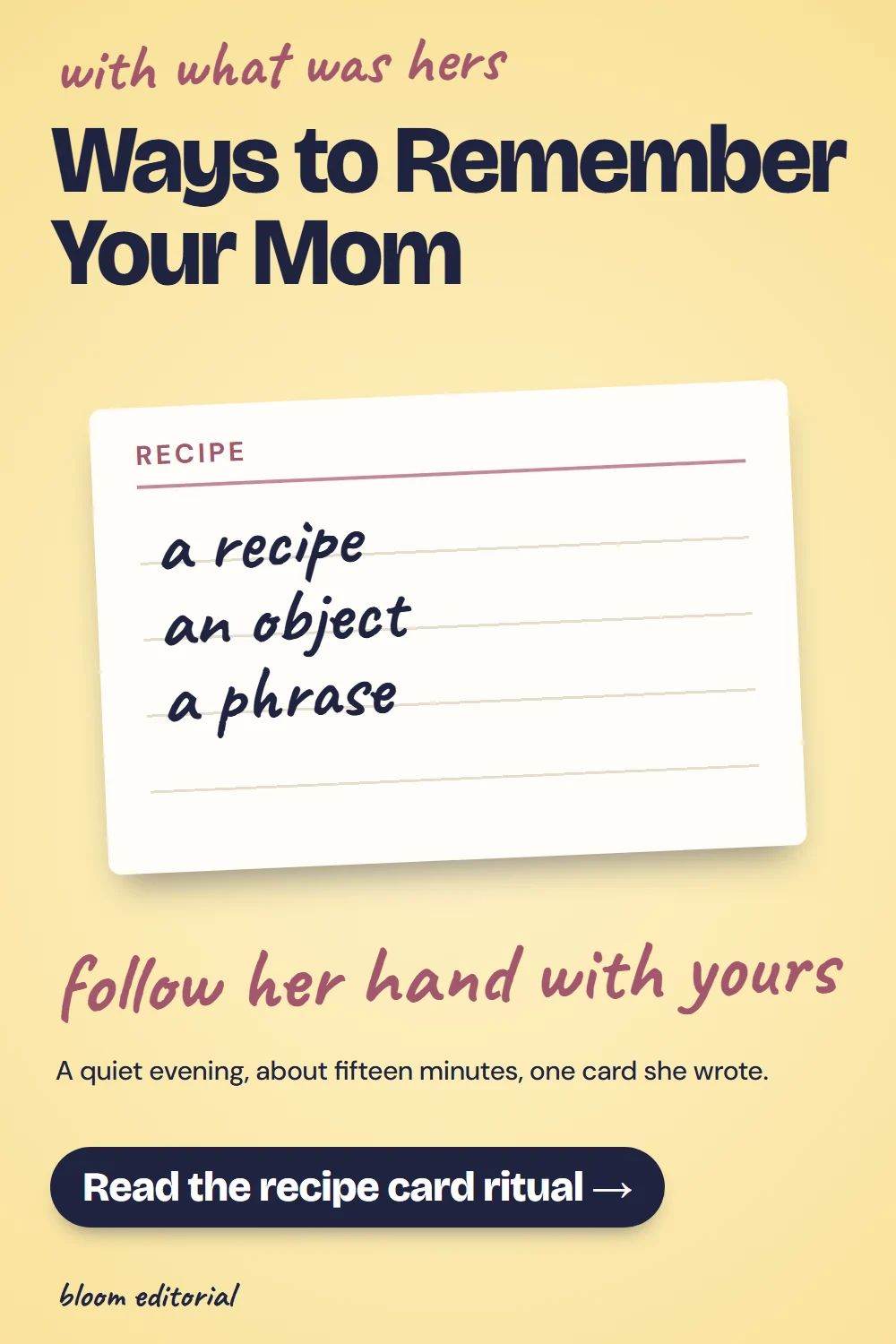

There is a drawer somewhere with her handwriting in it. A grocery list. A birthday card. A recipe card with a stain in the corner, from the year she made that dish for everyone.
You may not open the drawer often. Some days you cannot. Some days you open it only to see how she made her capital letters.
When you look for ways to remember your mom, you are often shown large things: a memorial, a framed portrait, a day set aside. This entry is about the small ones, the kind that fit on a kitchen table on an ordinary evening.
Small ways to remember your mom with what was hers
So much of a mother lives in small, repeated things. Three of them tend to stay in a house long after she is gone: a recipe, an object and a phrase.
A recipe. The card, the pan she always used, the note in the margin that says less salt or double this in ink that has started to fade. Cooking from it can feel like standing next to her. It can also feel unbearable. You might make the dish once and cry the whole time. You might not be ready to make it at all.
An object. Her reading glasses. A wooden spoon. The mug nobody else was allowed to use. Some daughters put the object back to work and stir the soup with her spoon. Others keep it where it can be touched without being looked at, in a coat pocket or the back of a drawer.
A phrase. What she said when you left the house. What she said when something broke. Some daughters say it out loud in the spot where she would have said it: at the door, at the stove, at the end of a call. A daughter might hear it come out of her own mouth one evening and stand still in the middle of the kitchen.
You do not need all three, and you do not need a ritual that looks a certain way. You only need something that feels like her.
Why her handwriting stops you
Handwriting is hers the way her voice was. The slant. The way she crossed her sevens. The abbreviations nobody else used.
A recipe card is also a record of use. The stain. The soft corner. The line she crossed out and wrote again. And it is never the whole recipe. The card holds what she wrote down, and the rest was only in her hands.
The card holds what she wrote down, and the rest was only in her hands.
That is why the ritual below is built around the card and not around the cooking. You do not have to turn on the stove. You do not have to write anything to her. You only have to follow her hand with yours.
The recipe card ritual, step by step
Set aside one quiet evening and about fifteen minutes. You will need one card in her handwriting, a blank index card or a sheet of paper, a pen and a clear table. If you have no recipe card, anything she wrote will do: a list, an envelope, the inside of a birthday card.
If it feels like too much once her card is in front of you, stop there and put it back. It will keep.
- Clear a space. Wipe the table and dry your hands. Lay her card down flat, away from the sink and the stove.
- Look before you read. Take in the card as a thing she held: the stain, the crease, the color of the ink, the places where she pressed harder.
- Read it out loud once. Go slowly, exactly as she wrote it, with her abbreviations and her notes in the margin.
- Copy it by hand. Write it onto the blank card line by line. Keep her wording, her spelling and her order. Do not correct anything, even the parts that make no sense.
- Add one thing the card does not say. In a corner of your copy, write one detail only her hands knew, if you remember one. She used the blue bowl. She never measured the flour. If you do not remember, write I do not know and leave it there.
- Put hers away safely. Take a photo of her card, then slide the original into an envelope, somewhere flat and dry. Your copy is the one that can live in the kitchen and collect its own stains.
You can cook from your copy next week, next year or never. As an example only: a daughter might copy her mother's pie crust card and leave the copy on the counter for a month before she buys flour. Another might never bake it, and keep the copy on the refrigerator.
What you might notice
You might notice nothing. Copying the card may feel like copying any list, and you may finish wondering what it was for.
It may hurt more for a moment, most often at the third step. Her words in your voice can land harder than her words on paper. If that happens, stop reading and sit with your hand flat on the table until the room feels steady again. You can go on, or you can finish another day.
You might see that your handwriting looks like hers in places, or nothing like hers at all. You might find a gap in the card: an ingredient with no amount, an oven with no temperature, a step she never wrote because she never needed to. You do not have to fill the gap. It was part of how she cooked.
I cannot promise the copy will comfort you. It is one way of keeping something of hers in use instead of in a drawer.
If the heaviness never lifts at all, or if you are having thoughts of harming yourself, please turn to a doctor, a counselor or a crisis line.
When to use it
- On a quiet evening when nothing has to be cooked and nobody needs you for a quarter of an hour.
- Before a day the dish belonged to, a holiday or her birthday, if you want your copy ready and her card kept clear of the stove.
- When something new turns up in her handwriting, in a box, a coat pocket or the back of a cupboard.
- With someone else at the table, a sister, a brother or your own child, each of you copying a different card, if you would rather not do this alone.
Once may be all you want. One card may be all there is. Nothing here has to be repeated or kept up.
Questions women ask about ways to remember your mom
What are small ways to remember your mom at home? Three things tend to stay in a house long after she is gone: a recipe, an object and a phrase. Some daughters stir the soup with her spoon, or say what she said at the door. You do not need all three.
What can I do with my mom's handwritten recipes? One thing is to copy a card by hand, line by line, in her wording and her spelling. Her card can go into an envelope, somewhere flat and dry, and your copy can live in the kitchen. You can cook from it next week, next year or never.
What if it hurts too much to look at my mom's handwriting? Some days you cannot open the drawer. If her card feels like too much once it is in front of you, put it back. It will keep.
The drawer is something you choose to open. Other moments choose you. For those, there is a short note you can write in the moment you reach for the phone to call her, for the thing you were going to say.
None of this is about moving on. Her card, her spoon, the thing she always said: they are still hers, and they are still in your house.